- bicondylar gonarthrosis/gonarthritis with preservation of the posterior cruciate ligament (exception: PE insert ultra also in cases of loss/damage of the PCL)
- intact collateral ligaments necessary

Overview
Primary endoprosthetics
The new 5C® Knee System
Developed by implantcast in collaboration with experts from five continents, the 5C® knee system (5 continents) represents global expertise and forward-thinking design. With four distinct system variants, each tailored to a specific kinematic principle, the system offers individualized solutions for a wide range of anatomical and functional needs.
Instability, patellofemoral complications, and symptoms resulting from poor fit or paradoxical kinematics are among the leading causes of revisions and patient dissatisfaction following total knee arthroplasty. The 5C® knee system directly addresses these challenges through a functionally driven design.
More about 5C®
ACS® knee system
The ACS® knee system (ACS® - advanced coated system) offers individual solutions for every patient thanks to its sophisticated modularity and combinability. The system features comprehensive unicondylar and bicondylar treatment options, from primary prostheses to revisions, with mobile or fixed-bearing solutions. The ACS® knee system is supplied with a titanium nitride (TiN) coating as standard but is also available without coating as an LD version (low-cost design).
Intraoperative adjustment of the prosthesis is particularly easy, as the bone-side contour of all ACS® femoral components is identical. This also applies beyond the system boundaries, allowing easy conversion to a MUTARS® GenuX® MK, a fully coupled system. The instruments ensure a simple, intuitive surgical technique. Navigation using the ROBIN navigation system is also possible.
More than 20 years of experience
The global presence of the ACS® knee system has been steadily expanded over the last 20 years – today it is available in more than 50 countries 1). Since its market launch in 2002, a total of around 320,000 ACS® implants 1) have been sold. (1) As of 07/2025)
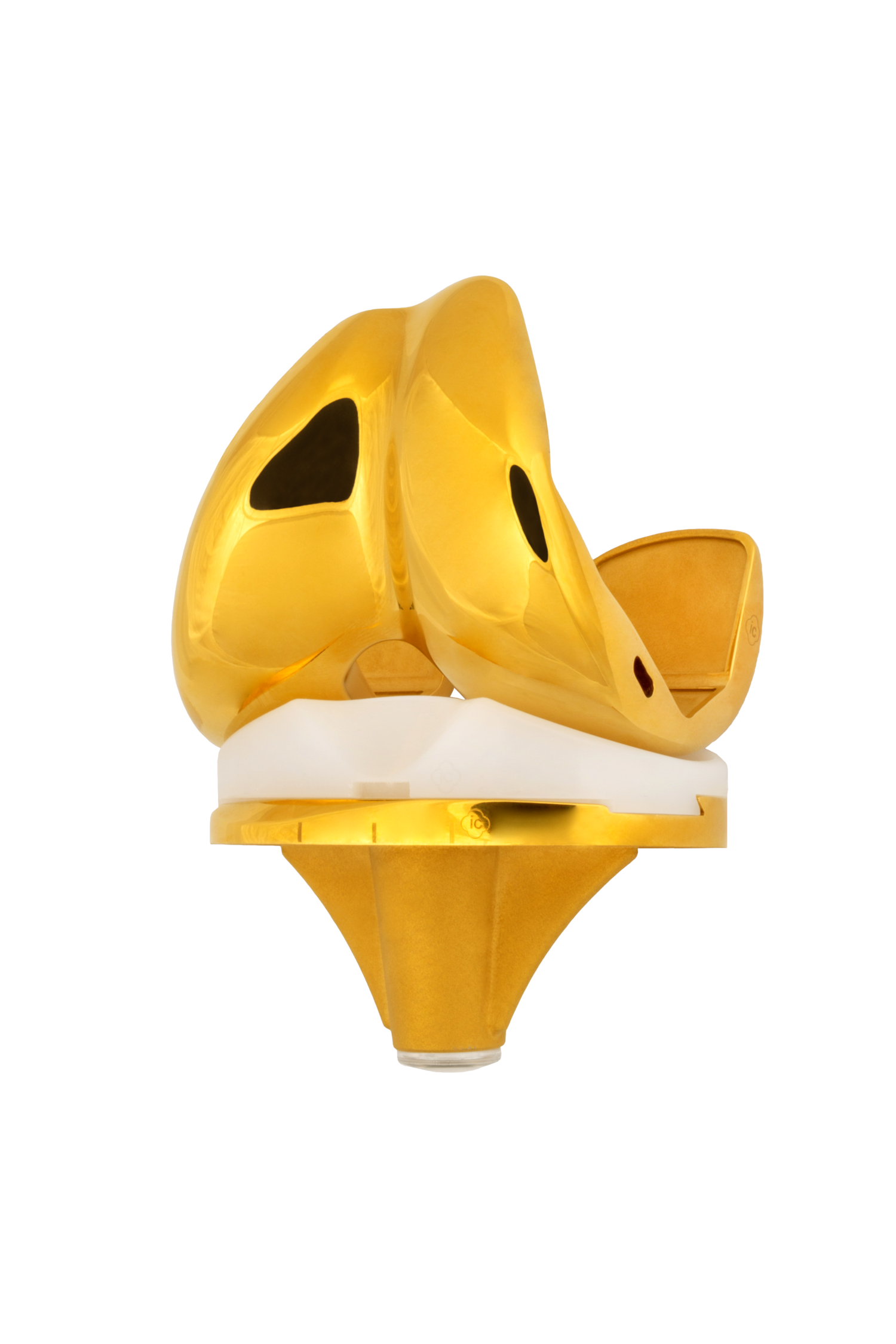
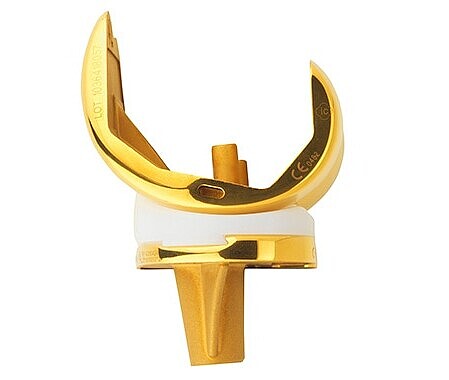
ACS® FB+ – fixed-bearing system
The primary knee system ACS® FB+ is used in cases where the posterior cruciate ligament (PCL) is preserved. A fixed connection between the ACS® FB+ tibial component and the primary PE insert is the main feature and defining design element of the fixed-bearing system. PE inserts with different degrees of congruence (standard, hyperflex, ultra) are available, allowing for different degrees of mobility between the femoral component and the PE insert.
If required, the primary ACS® FB+ system can be combined with tibial shaft extensions, spacers, and 360° freely adjustable offset adapters.
The ACS® FB+ implants cover the entire range of bicondylar primary arthroplasty through to semi-constrained revision arthroplasty. What makes the system unique is that the same tibial component is used for all ACS® FB+ indications. Depending on the clinical requirements, the ACS® FB+ tibial component is combined with different PE inserts and femoral components.
All ACS® femoral components feature an asymmetrical, anatomically shaped design to fit the anatomy of the femur as closely as possible. The articulating surfaces have a multi-radius design (J-curve profile).
The asymmetrical, anatomical design of the ACS® FB+ tibial component ensures optimal bone coverage of the proximal tibia. Furthermore, the ACS® FB+ tibial component has a 5° slope.
- implavit®; CoCrMo according to ISO 5832-4 (femoral and tibial components)
- UHMWPE according to ISO 5834-2 (PE inserts)
- implacross® E; crosslinked UHMWPE with vitamin E (PE inserts)
- TiN coating
- porous coating on surfaces for cementless fixation
- 12 femoral sizes
- 5 sizes of PE inserts in thicknesses of 10 mm to 20 mm (three designs: standard, hyperflex, ultra)
- 6 tibial sizes (cementless version with extension stem)
- cemented and cementless version
- coated und non-coated version
- compatible with:
- ACS® PE patella
- ACS® rotating patella
- tibial stem extensions
- tibial spacers
- CE Marking
- FDA Approvals
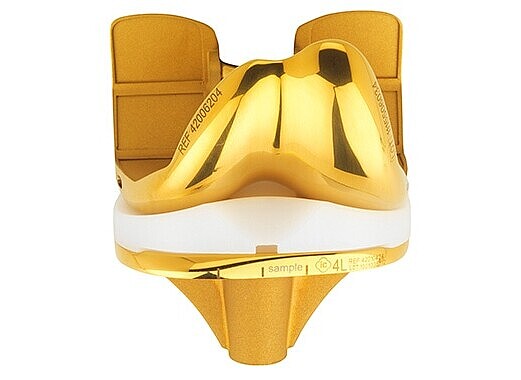
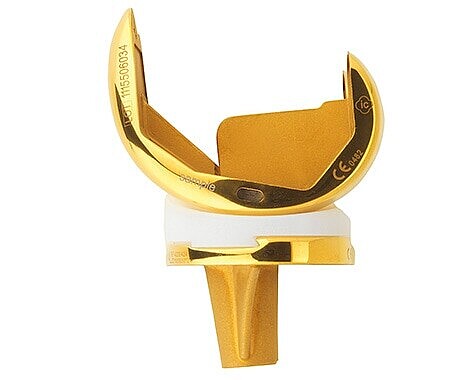
ACS® FB+ PS – fixed-bearing system posterior stabilized
The ACS® FB+ PS knee system (PS = posterior stabilized) is used for the functional replacement of the posterior cruciate ligament. The femoral spindle and PE peg provide posterior stabilization of the knee joint during articulation between femoral and tibial component. A fixed connection between the ACS® FB+ tibial component and the ACS® FB+ PS PE insert is the main feature and defining design element of the fixed-bearing system.
If required, the primary ACS® FB+ system can be combined with tibial shaft extensions, spacers, and 360° freely adjustable offset adapters.
The ACS® FB+ implants cover the entire range of bicondylar primary arthroplasty through to semi-constrained revision arthroplasty. What makes the system unique is that the same tibial component is used for all ACS® FB+ indications. Depending on the clinical requirements, the ACS® FB+ tibial component is combined with different PE inserts and femoral components.
- bicondylar gonarthrosis/gonarthritis with concurrent loss/damage of both cruciate ligaments
- intact collateral ligaments necessary
All ACS® femoral components feature an asymmetrical, anatomically shaped design to fit the anatomy of the femur as closely as possible. The articulating surfaces have a multi-radius design (J-curve profile). The size-independent box width and height allow flexibility in selecting the size of the ACS® PS femoral component. The dimensions of the box (width and height) are identical to those of the ACS® SC femoral component.
The asymmetrical, anatomical design of the ACS® FB+ tibial component ensures optimal bone coverage of the proximal tibia. Furthermore, the ACS® FB+ tibial component has a 5° slope.
- implavit®; CoCrMo according to ISO 5832-4 (femoral and tibial components)
- UHMWPE according to ISO 5834-2 (PE inserts)
- implacross® E; crosslinked UHMWPE with vitamin E (PE inserts)
- TiN coating
- porous coating on surfaces for cementless fixation
- 11 femoral sizes
- 5 sizes of PE inserts in thicknesses from 10 mm to 20 mm
- 6 tibial sizes (cementless version with extension stem)
- cemented and cementless version
- coated und non-coated version
- compatible with:
- ACS® PE patella
- ACS® rotating patella
- tibial stem extensions
- tibial spacers
- CE Marking
- FDA Approvals
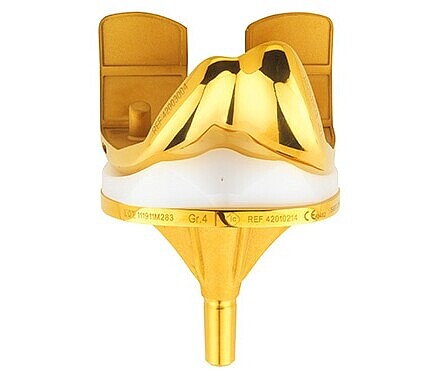
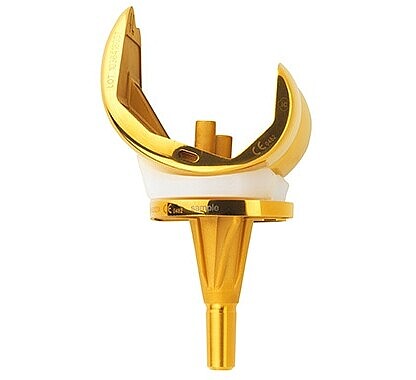
ACS® MB – mobile-bearing system
The primary knee system ACS® MB is used in cases where the posterior cruciate ligament is preserved. The key design feature of the ACS® Mobile-Bearing-Systems is the free rotational movement of the PE insert on the tibial component. There is a high degree of congruence between the bearing surface and the femoral component. PE inserts with different degrees of congruence (standard, deep dish) are available, allowing for different degrees of mobility between the femoral component and the PE insert.
If required, the primary ACS® MB system can be combined with tibial shaft extensions and 360° freely adjustable offset adapters.
The implants of the ACS® MB system cover the entire range of bicondylar primary arthroplasty through to semi-constrained revision arthroplasty. The same primary ACS® MB tibial component is used in the primary ACS® MB and ACS® MB PS systems.
- bicondylar gonarthrosis/gonarthritis with concurrent loss/damage of both cruciate ligaments
- preservation of the posterior cruciate ligament possible
- intact collateral ligaments necessary
All ACS® femoral components feature an asymmetrical, anatomically shaped design to fit the anatomy of the femur as closely as possible. The articulating surfaces have a multi-radius design (J-curve profile).
The ACS® MB tibial component has a symmetrical design, allowing it to be used on both the left and right sides. A posterior cut-out allows the posterior cruciate ligament to be preserved.
- implavit®; CoCrMo according to ISO 5832-4 (femoral and tibial components)
- UHMWPE according to ISO 5834-2 (PE inserts)
- TiN coating
- porous coating on surfaces for cementless fixation
- 12 femoral sizes
- 6 sizes of PE inserts in thicknesses from 10 mm to 20 mm (three designs: standard, deep dish)
- 7 tibial sizes
- cemented and cementless version
- coated und non-coated version
- compatible with:
- ACS® PE patella
- ACS® rotating patella
- tibial stem extensions
- CE Marking
- FDA Approvals
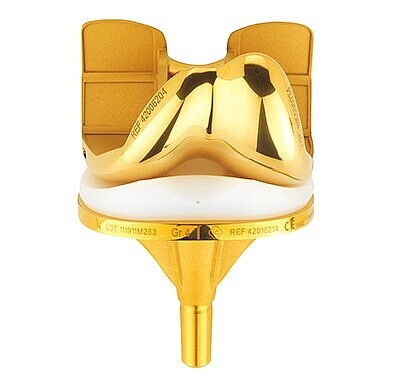
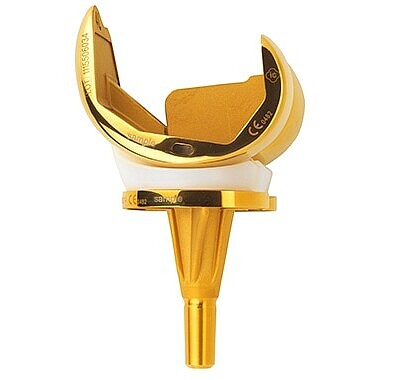
ACS® MB PS – mobile-bearing system posterior stabilized
The ACS® MB PS (PS = posterior stabilized) system is used as a functional replacement for the posterior cruciate ligament. The femoral spindle and PE peg provide posterior stabilization of the knee joint during articulation between the femoral and tibial components. During articulation between the femoral and tibial component, the PE peg is guided in the femoral socket and stabilized by the femoral spindle.
If required, the primary ACS® MB system can be combined with tibial shaft extensions and 360° freely adjustable offset adapters.
The implants of the ACS® MB system cover the entire range of bicondylar primary arthroplasty through to semi-constrained revision arthroplasty. The same primary ACS® MB tibial component is used in the primary ACS® MB and ACS® MB PS systems.
- bicondylar gonarthrosis/gonarthritis with concurrent loss/damage of both cruciate ligaments
- intact collateral ligaments necessary
All ACS® femoral components feature an asymmetrical, anatomically shaped design to fit the anatomy of the femur as closely as possible. The articulating surfaces have a multi-radius design (J-curve profile). The size-independent box width and height allow flexibility in selecting the size of the ACS® PS femoral component. The dimensions of the box (width and height) are identical to those of the ACS® SC femoral component.
The ACS® MB tibial component has a symmetrical design, allowing it to be used on both the left and right sides. A posterior cut-out allows the posterior cruciate ligament to be preserved.
- implavit®; CoCrMo according to ISO 5832-4 (femoral and tibial components)
- UHMWPE according to ISO 5834-2 (PE inserts)
- TiN coating
- porous coating on surfaces for cementless fixation
- 11 femoral sizes
- 5 sizes of PE-inserts in thicknesses from 10mm to 20mm
- 7 tibial sizes (design standard)
- cemented and cementless version
- coated und non-coated version
- compatible with:
- ACS® PE patella
- ACS® rotating patella
- tibial stem extensions
- CE Marking
- FDA Approvals
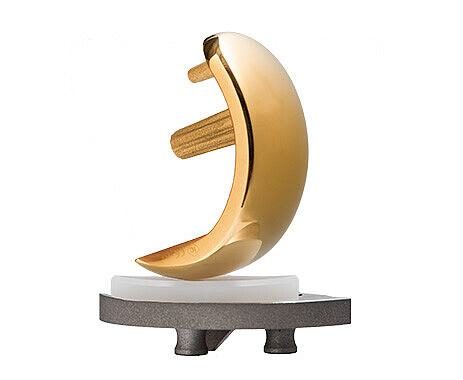
ACS® Uni FB – unicondylar fixed bearing surface replacement
The ACS® Uni FB is a unicondylar knee system designed to preserve the natural kinematics of the knee joint after reconstruction of the joint line. Among its notable features is an asymmetrically shaped tibial component that ensures optimal bone coverage as well as anatomical fit of the femoral component.
Reduced metal ion release is possible thanks to the standard TiN coating of the femoral component1),2) combined with the tibial component made of a titanium alloy.
1) Dempwolf H (2013): Entwicklung und Charakterisierung neuartiger PVD-Beschichtungen zur Allergievermeidung und Verschleißminderung in der Endoprothetik, Bachelorarbeit Universität, Rostock
2) Baumann A. (2001): Keramische Beschichtungen in der KTEP Standardlösung für Allergiker. JATROS Orthopädie & Rheumatologie 6: 16-17
- unicondylare osteoarthritis
- intact ligamentous apparatus
- intact opposite compartment
- no significant deformity or flexion contrature
The ACS® Uni femoral components feature a symmetrical design with two pegs and one fin for optimal stability and rotational fixation. The articulation surfaces have a multi-radius design (J-curve profile), which enables natural kinematics as well as a reduced risk of posterior overstuffing and anterior impingement. The unrestricted movement of the femoral component on the flat PE insert design promotes natural kinematics.
The asymmetrical ACS® Uni FB tibial component with two pegs and one fin enables optimal bone coverage and rotationally stable fixation in the tibia.
- implavit®; CoCrMo according to ISO 5832-4 (femoral component)
- implantan®; TiAl6V4 according to ISO 5832-3 (tibial component)
- implacross® E; UHMWPE mit Vitamin E according to ISO 5834-1 (PE-insert)
- UHMWPE according to ISO 5834-2 (PE-insert)
- TiN-coating
- implaFix®; cpTi coating on surfaces for cementless fixation
- 4 femoral sizes
- 5 sizes PE-inserts (height tibia+insert: 8, 9, 10, 11, 12, 14 mm)
- 7 tibiale Größen
- femoral cemented and cementless version
- tibial cemented version
- CE Marking
- FDA Approvals
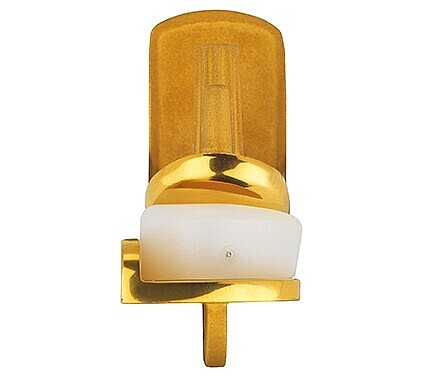
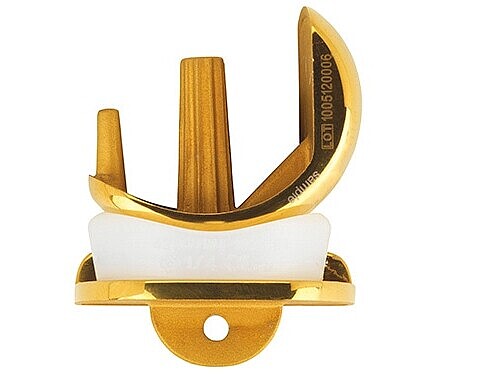
ACS® Uni MB – unicondylar mobile bearing surface replacement
The ACS® Uni MB is a unicondylar knee system designed to preserve the natural kinematics of the knee joint after reconstruction of the joint line. Das System zeichnet sich durch seine hohe Kongruenz zwischen Femurkomponente und dem auf der Tibiakomponente liegenden PE-Einsatz aus as well as anatomical fit of the femoral component.
Reduced metal ion release is possible thanks to the standard TiN coating of the femoral and tibial component.1),2)
1) Dempwolf H (2013): Entwicklung und Charakterisierung neuartiger PVD-Beschichtungen zur Allergievermeidung und Verschleißminderung in der Endoprothetik, Bachelorarbeit Universität, Rostock
2) Baumann A. (2001): Keramische Beschichtungen in der KTEP Standardlösung für Allergiker. JATROS Orthopädie & Rheumatologie 6: 16-17
- unicondylare osteoarthritis
- intact ligamentous apparatus
- intact opposite compartment
- no significant deformity or flexion contrature
The ACS® Uni femoral components feature a symmetrical design with two pegs and one fin for optimal stability and rotational fixation. The articulation surfaces have a multi-radius design (J-curve profile), which enables natural kinematics as well as a reduced risk of posterior overstuffing and anterior impingement. Die hohe Kongruenz zwischen der Femurkomponente und dem PE-Einsatz gewährleistet einen hohen Flächenkontakt über den gesamten Bewegungsumfang, was die Aufnahme der Rollbewegung der natürlichen Kinematik möglich macht.
Eine rotationsstabile Verankerung im tibialen Knochen ermöglicht die symmetrische ACS® Uni MB Tibiakomponente mit einer zentrierten Finne.
- implavit®; CoCrMo according to ISO 5832-4 (femoral and tibial component)
- UHMWPE according to ISO 5834-2 (PE-insert)
- TiN-coating
- implaFix®; cpTi coating on surfaces for cementless fixation
- 4 femoral sizes
- 4 sizes PE-inserts (height insert: 4, 5, 6, 7, 8, 9, 10, 11, 12 mm)
- 8 tibial sizes
- cemented and cementless version
- CE Marking
- FDA Approvals
Revision endoprosthetics
Revision Systems
The implantcast revision knee system range offers treatment options ranging from partially coupled bicondylar surface replacement to fully coupled bicondylar surface replacement and fully coupled condylar reconstruction knee systems, with mobile or fixed-bearing solutions. Thanks to their sophisticated modularity, individual solutions can be offered for every patient.
The implantcast portfolio includes various revision knee systems: the ACS® SC, MUTARS® GenuX MK and MUTARS® KRI MK. Intraoperative adjustment of the prosthesis is particularly easy due to the modularity of the systems and the identical bone-side contour of all ACS® and MUTARS® GenuX® MK femoral components.
The instruments ensure a simple, intuitive surgical technique. Navigation using the ROBIN navigation system is also possible.
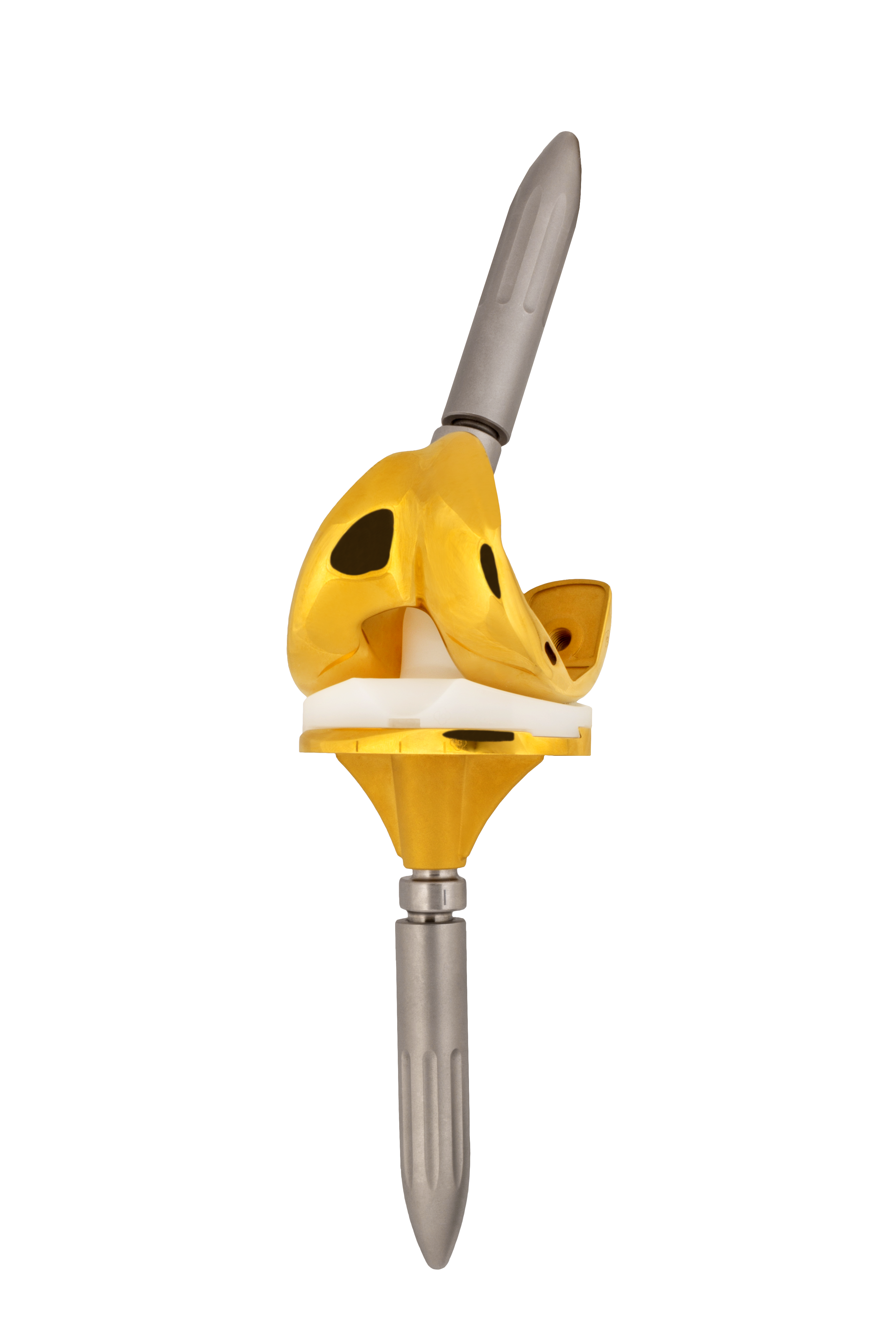
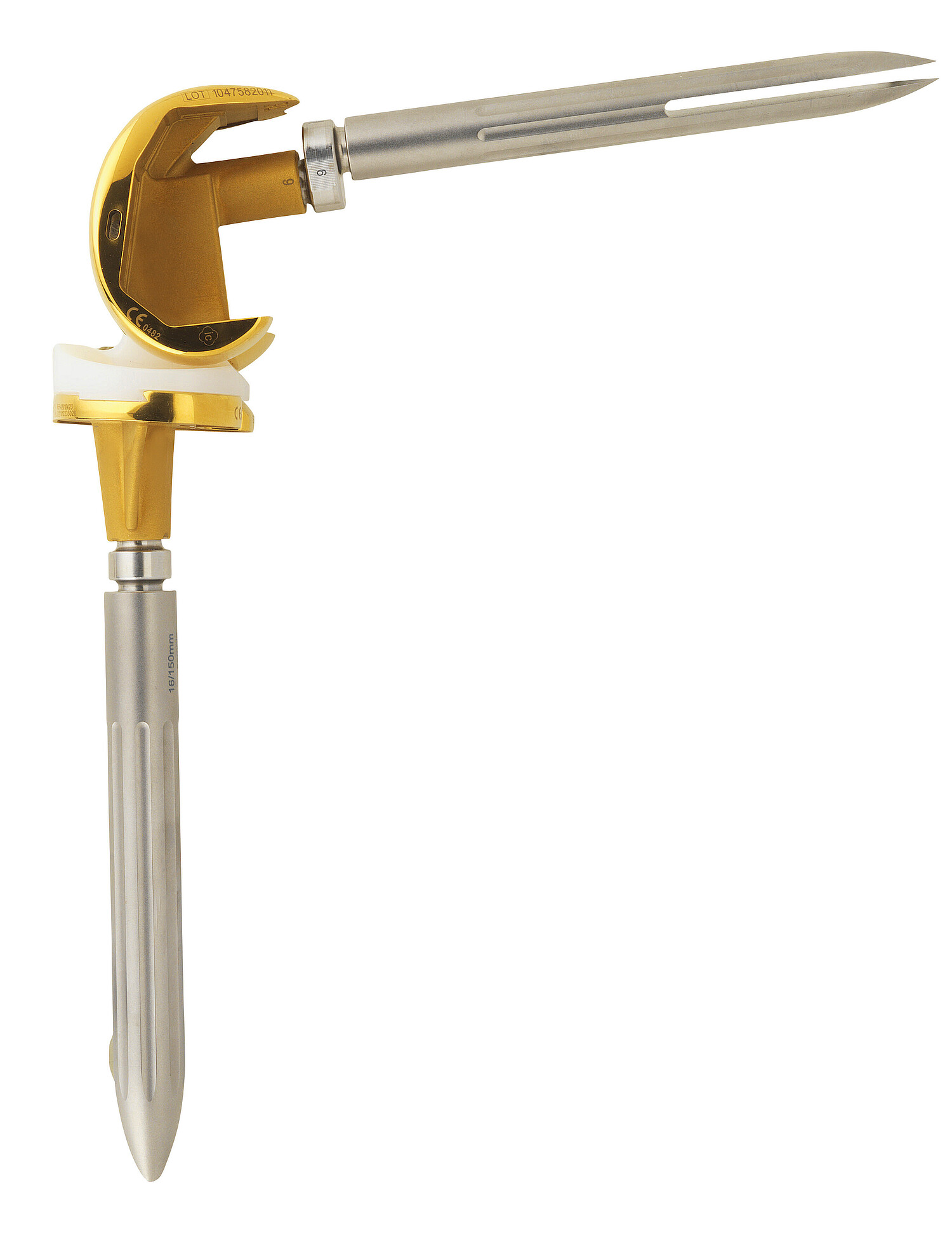
ACS® FB+ SC – fixed-bearing system semi-constrained
The ACS® FB+ SC system (SC = semi-constrained) is used as a functional replacement for the posterior cruciate ligament with additional varus/valgus stabilization in cases of collateral ligament instability. During articulation between the femoral and tibial components, the PE peg is guided in the femoral box and stabilized by the femoral spindle. A fixed connection between the ACS® FB+ tibial component and the ACS® FB+ SC PE insert is the main feature and defining design element of the fixed-bearing system.
The ACS® FB+ SC system offers the option of connecting stem extensions to the femoral and tibial components via 360° freely adjustable offset adapters, as well as compensating for bone defects with the aid of spacers. In addition, larger bone defects can be treated by combining ACS® SC prostheses with EPORE® defect fillers without having to switch to a fully coupled prosthesis.
The ACS® FB+ implants cover the entire range of bicondylar primary arthroplasty through to semi-constrained revision arthroplasty. What makes the system unique is that the same tibial component is used for all ACS® FB+ indications. Depending on the clinical requirements, the ACS® FB+ tibial component is combined with different PE inserts and femoral components.
- revision of primary knee joint replacement with loss/damage of both cruciate ligaments and instability of the collateral ligaments with femoral and/or tibial bone defects
All ACS® femoral components feature an asymmetrical, anatomically shaped design to fit the anatomy of the femur as closely as possible. The articulating surfaces have a multi-radius design (J-curve profile). The size-independent box width and height allow flexibility in selecting the size of the ACS® SC femoral component. The dimensions of the box (width and height) are identical to those of the ACS® PS femoral component. Additionally, the taper connection of the ACS® SC femoral component has an integrated valgus angle of 6°, which facilitates the implantation of components with stem extensions..
The asymmetrical, anatomical design of the ACS® FB+ tibial component ensures optimal bone coverage of the proximal tibia. Furthermore, the ACS® FB+ tibial component has a 5° slope.
- implavit®; CoCrMo according to ISO 5832-4 (femoral and tibial components)
- UHMWPE according to ISO 5834-2 (PE inserts)
- implacross® E; crosslinked UHMWPE with vitamin E (PE inserts)
- implatan®; TiAl6V4 according to ISO 5832-3 (stems, double taper and spacer)
- TiN coating
- porous coating on surfaces for cementless fixation (femoral and tibial components)
- implaFix® HA; HA coating according to ISO 13779-2 (cementless HA-coated stems)
- 6 femoral sizes
- 5 sizes of PE inserts in thicknesses from 10 mm to 20 mm
- 7 tibial sizes
- cemented and cementless version
- coated und non-coated version
Compatible with:
- ACS® PE patella
- ACS® rotating patella
- Offset adapter (femoral: 0 mm, 2 mm, 4 mm, 6 mm; tibial: 0 mm, 2 mm, 4 mm and 6 mm)
- 16 stem versions: uncoated or HA coated
(lengths: 100 mm, 150 mm and 200 mm; diameter: 12 mm, 14 mm, 16 mm, 18 mm, 20 mm, 22 mm)
Applicable only for cemented fixation:
- Spacers: femoral (posterior and distal, each in 5 mm and 10 mm), tibial (5 mm and 10 mm)
- EPORE® defect fillers (cones and metaphyseal components)
- CE Marking
- FDA Approvals
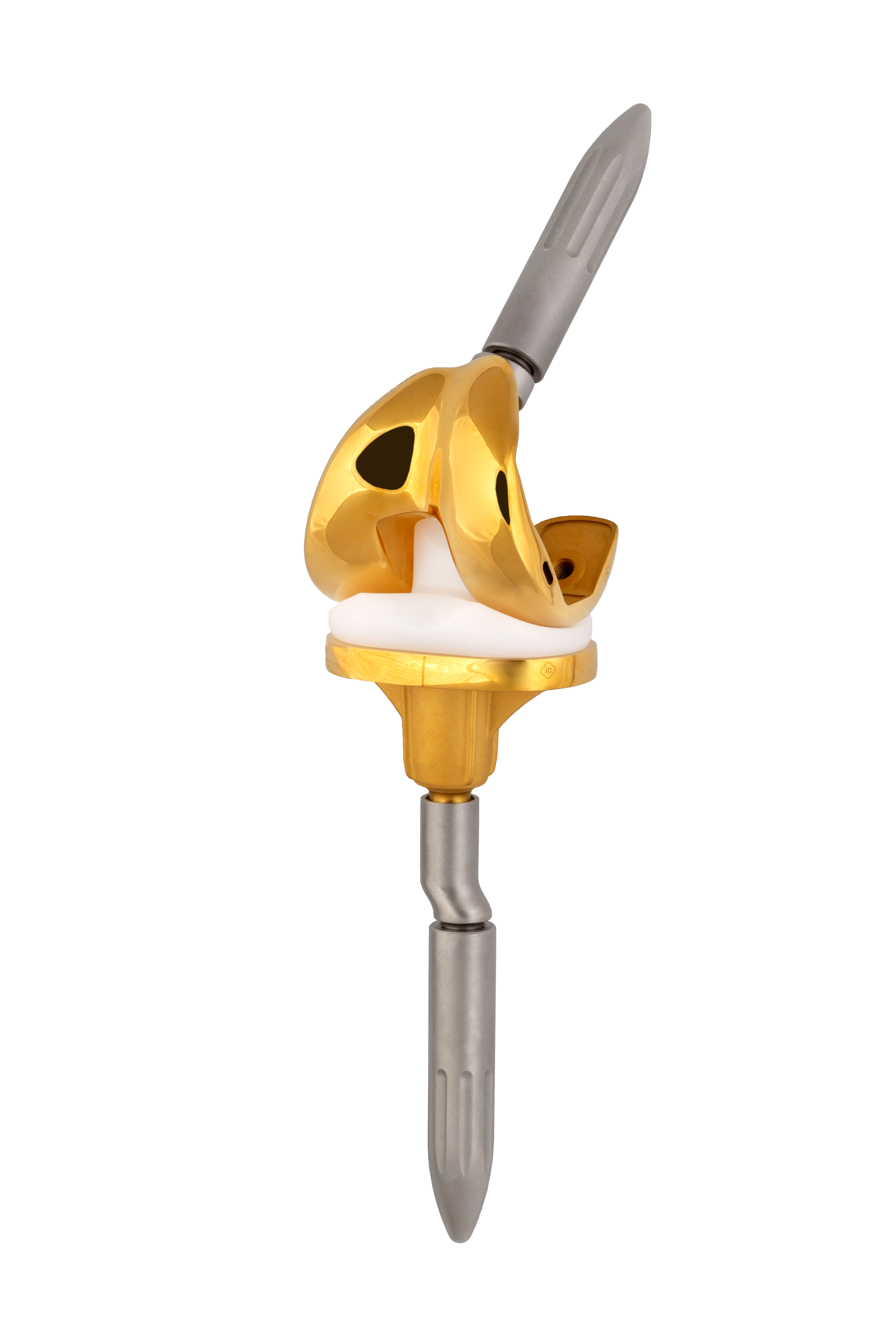
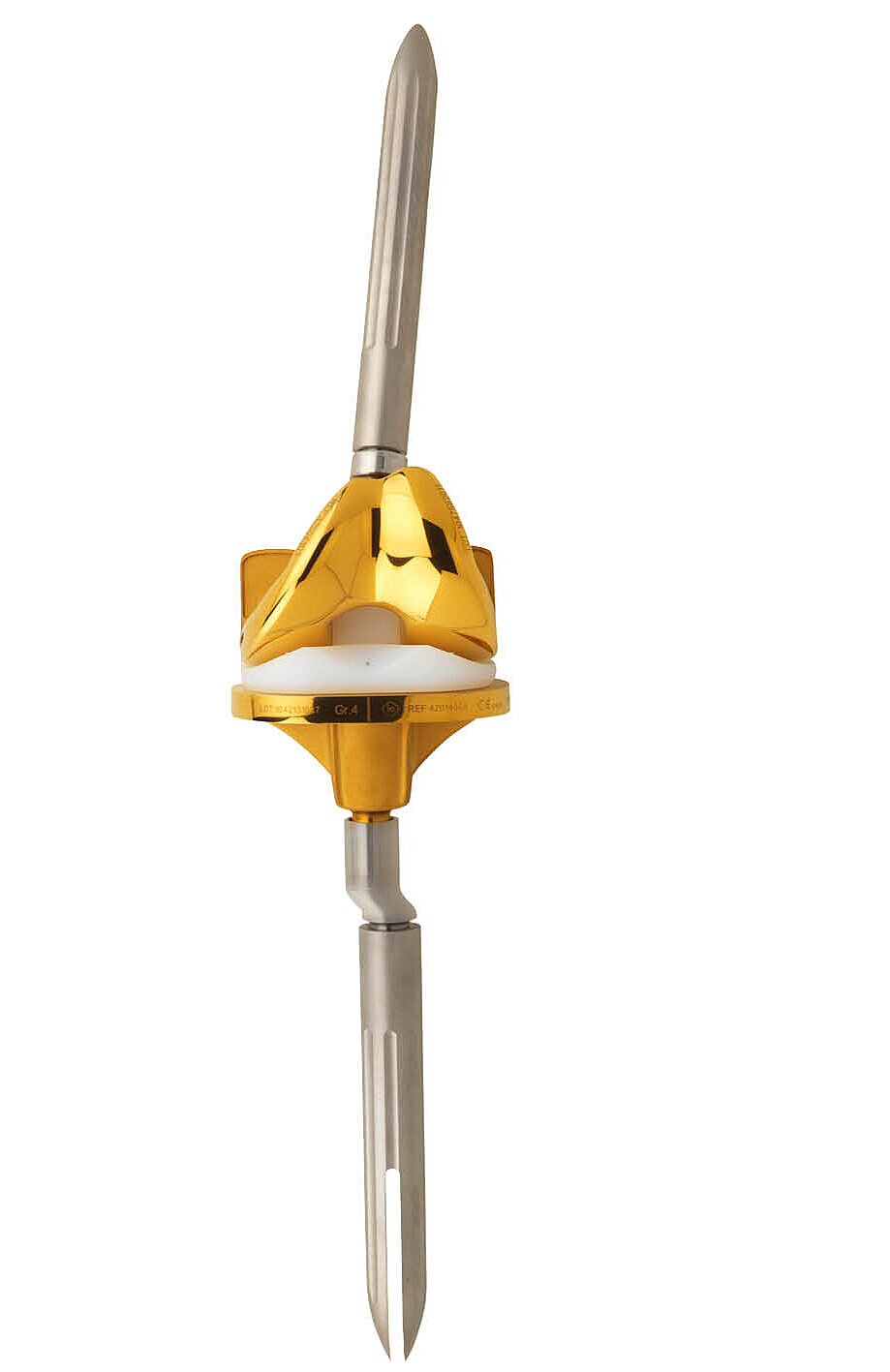
ACS® MB SC – mobile-bearing system semi-constrained
The ACS® MB SC (SC = semi-constrained) system is used as a functional replacement for the posterior cruciate ligament and provides additional varus/valgus stabilization in cases of collateral ligament instability. During articulation between the femoral and tibial components, the PE peg is guided in the femoral socket and stabilized by the femoral spindle. The key design feature of the Mobile-Bearing-Systems is the free rotational movement of the PE insert on the tibial component. There is a high degree of congruence between the bearing surface and the femoral component.
The ACS® MB SC system offers the option of connecting stem extensions to the femoral and the tibial component using offset adapters that can be positioned freely through 360°, as well as compensating for bone defects with the aid of spacers. In addition, larger bone defects can be treated by combining prostheses from the ACS® SC system with EPORE® defect fillers without having to switch to a fully constrained prosthesis.
The implants of the ACS® MB system cover the entire range of bicondylar primary arthoplasty to semi-constrained revision arthoplasty.
- revision of primary knee joint replacement with loss/damage of both cruciate ligaments and instability of the collateral ligaments with the presence of femoral and/or tibial bone defects
All ACS® femoral components feature an asymmetric, anatomically shaped design to ensure optimal adaptation to the natural anatomy of the femur. The articulating surfaces incorporate a multi-radius design (J-curve profile). The size-independent box width and height allow flexibility in selecting the size of the ACS® SC femoral component. The dimensions of the box (width and height) are identical to those of the ACS® PS femoral component. Additionally, the taper connection of the ACS® SC femoral component incorporates a 6° valgus angle, facilitating the implantation of components with stem extensions.
The ACS® MB SC tibial component has a symmetrical design. The current design is identical to the primary ACS® MB tibial components in terms of AP and ML dimensions and radii. The outer contour is identical to that of the MUTARS® GenuX® MK system.
- implavit®; CoCrMo according to ISO 5832-4 (femoral and tibial components)
- UHMWPE according to ISO 5834-2 (PE inserts)
- implatan®; TiAl6V4 according to ISO 5832-3 (stems, double tapers, and spacers)
- TiN coating
- porous coating on surfaces for cementless fixation (femoral and tibial components)
- implaFix® HA; HA coating according to ISO 13779-2 (cementless HA-coated stems)
- 6 femoral sizes
- 5 sizes of PE inserts in thicknesses from 10 mm to 20 mm
- 5 tibial sizes
- cemented and cementless version
- coated und non-coated version
Compatible with:
- ACS® PE patella
- ACS® rotating patelle
- Offset adapters (femoral: 0 mm, 2 mm, 4 mm, 6 mm; tibial: 0 mm, 2 mm, 4 mm and 6 mm)
- 16 stems versions: uncoated or HA-coated
(lengths: 100 mm, 150 mm and 200 mm; diameter: 12 mm, 14 mm, 16 mm, 18 mm, 20 mm, 22 mm)
Only for cemented fixation:
- Spacers: femoral (posterior and distal, each in 5 mm and 10 mm), tibial (5 mm and 10 mm)
- EPORE® defect fillers (Cones and metaphyseal components)
- CE Marking
- FDA Approvals
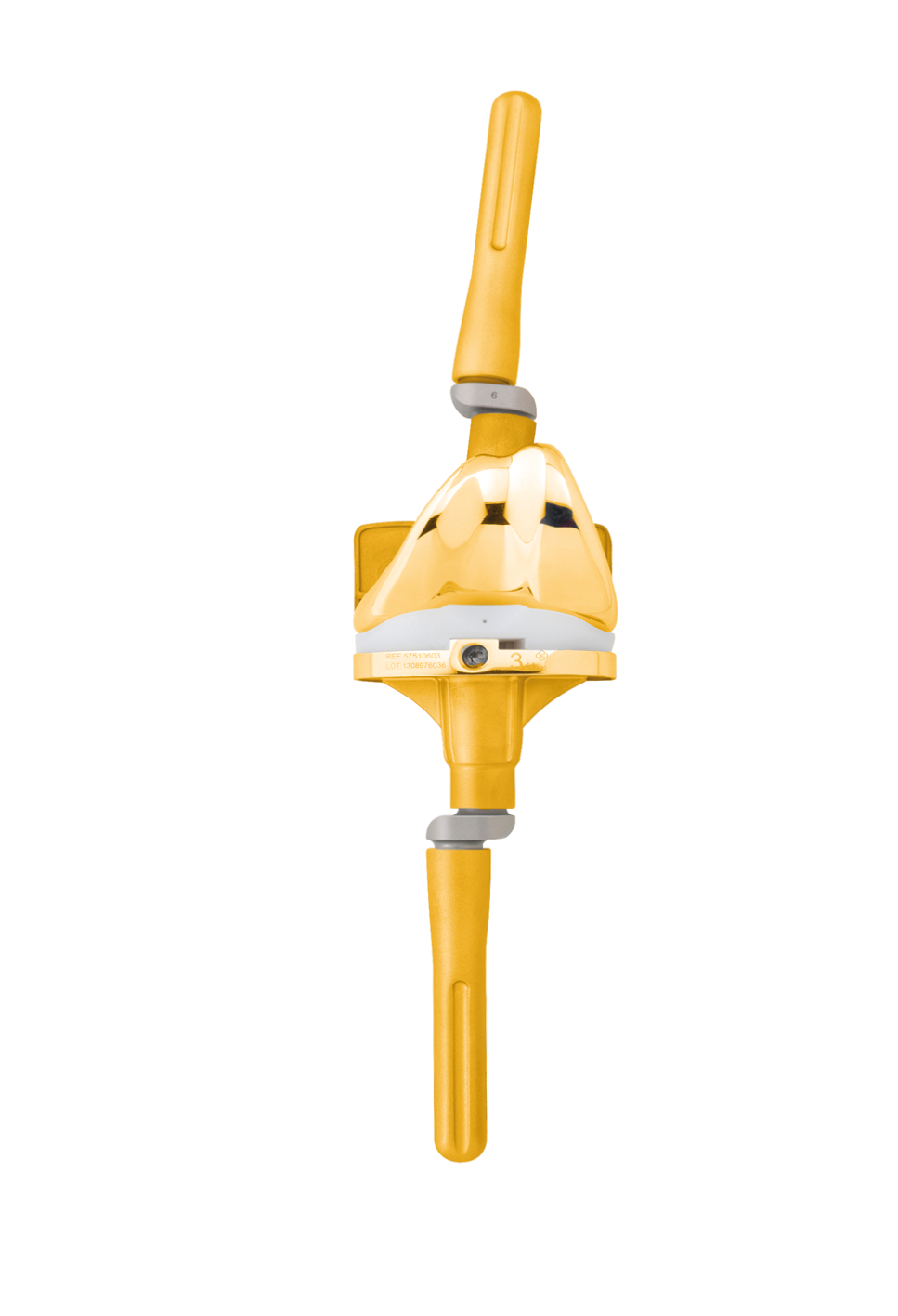
MUTARS® GenuX® MK
The MUTARS® GenuX® MK is a fully coupled revision knee system. Its modular architecture enables the use of different offset adapters, stems, and spacers to meet individual clinical needs. The biomechanically optimized coupling between the femoral and tibial components provides multidirectional stability while permitting up to 130° of knee flexion. For the reconstruction of extensive bone defects, the system can be combined with EPORE® Cones and metaphyseal components.
The 360° freely adjustable offset adapters allow optimal positioning of the joint components following initial stem preparation. This ensures that, even when excellent stem fixation has been achieved, the joint components can still be aligned optimally. This contributes to improved bone coverage. Various PE insert heights are also available, enabling adjustment of the joint line via the polyethylene insert when a tibial component has already been implanted. Furthermore, the system is optionally available with a TiN coating. Thanks to this ceramic coating, the components exhibit improved wettability while ion release is minimized.
The MUTARS® GenuX® MK is also available in an HD version. For more information, please follow this link: HD Focus Page
- revision surgery
- extensive bone loss (AORI Type 2-3)
- loss of the cruciate and collateral ligament
- fully coupled knee system
- high degree of modularity and compatibility
- fixed-bearing polyethylene inserts and mobile-bearing PE inserts with up to 20° of rotation, available in various heights
- cemented and cementless femoral and tibial components
- cemented and cementless stem options
- 360° freely adjustable offset
- femoral and tibial spacer fixation
- EPORE® Cones and EPORE® metaphyseal components
- compatible with cemented MUTARS® patellar resurfacing components
- implatan®; TiAl6V4 according to ISO 5832-3 (offset adapter, spacer, MUTARS® GenuX® MK cementless stems)
- implavit®; CoCrMo according to ISO 5832-4 (MUTARS® GenuX® MK femur, MUTARS® GenuX® MK tibia, MUTARS® GenuX® MK cemented stems)
- implavit®; CoCrMo according to ISO 5832-12 (MUTARS® coupling)
- UHMWPE according to ISO 5834-2 und implacross® E; corss-linked UHMWPE with vitamin E (MUTARS® GenuX® MK PE inserts)
- TiN coating (optional for MUTARS® GenuX® MK femoral und tibial components, MUTARS® GenuX® MK cemented stems)
- TiNbN coating (optional for MUTARS® coupling)
- implaFix® HA; HA coating accordning to ISO 13779-2 (optional for MUTARS® GenuX® MK cementless stems)
- silver coating (optional for MK femoral and tibial spacer)
- MUTARS® GenuX® MK stems
- 4 MUTARS® GenuX® MK offset options: 0 mm, 2 mm, 4 mm and 6 mm
- 5 MUTARS® GenuX® MK femoral and tibial components: sz. 2 – 6
- 3 options of MUTARS® coupling: 12.5 mm, 15 mm and 17.5 mm
- 3 heigths of MUTARS® GenuX® MK PE inserts: 12.5 mm, 15 mm and 17.5 mm
- MK femoral and tibial spacer
- MUTARS® patellar replacement
- CE Marking
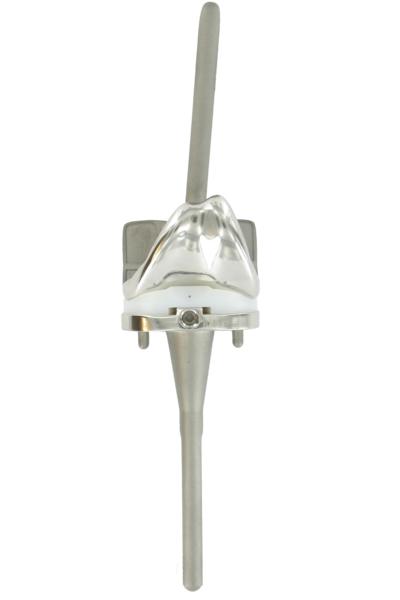
MUTARS® GenuX® MK Monoblock
The MUTARS® GenuX® MK monoblock offers a solution for cemented revision of the knee joint without major bone defects. The precisely coordinated components ensure an optimal fit and functionality to improve the mobility and quality of life of patients1),2). The simplicity of the system allows for easy preparation without modular components.
A key feature of the system is its consistent simplicity: the straightforward preparation significantly facilitates the surgical procedure. The femoral component, tibial component, and stem are each manufactured as a single-piece monoblock construction and can be implanted in a single surgical step.
In addition, the MUTARS® GenuX® MK monoblock is available in an HD version.
For more information, please follow this link: HD Focus Page
1) Pala E, Trovarelli G, Ippolito V, Berizzi A, Ruggieri P. A long-term experience with Mutars tumor megaprostheses: analysis of 187 cases. Eur J Trauma Emerg Surg. 2022 Jun;48(3):2483-2491. doi: 10.1007/s00068-021-01809-7. Epub 2021 Nov 2. PMID: 34727192.
2) Henrichs MP, Krebs J, Gosheger G, Streitbuerger A, Nottrott M, Sauer T, Hoell S, Singh G, Hardes J. Modular tumor endoprostheses in surgical palliation of long-bone metastases: a reduction in tumor burden and a durable reconstruction. World J Surg Oncol. 2014 Nov 7;12:330. doi: 10.1186/1477-7819-12-330. PMID: 25376274; PMCID: PMC4289050.
- coupled, cemented revision treatment of the knee joint without major bone defects
- fully coupled knee system
- fixed-bearing polyethylene inserts and mobile-bearing PE inserts with up to 20° of rotation, available in various heights
- cemented femoral and tibial components
- stem length 125 mm and various diameters
- femur/tibial component and stem made from a single casting (monoblock)
- implavit®; CoCrMo according to ISO 5832-4 (MUTARS® GenuX® MK femur monoblock and tibia monoblock)
- implavit®; CoCrMo nach ISO 5832-12 (MUTARS® coupling)
- UHMWPE according to ISO 5834-2 and implacross® E; cross-linked UHMWPE with vitamin E (MUTARS® GenuX® MK PE inserts)
- TiNbN coating (optional for MUTARS® coupling)
- 4 MUTARS® GenuX® MK femur monoblock cemented: sz. 2/10 mm, 3/11 mm, 4/12 mm and 5/13 mm
- 4 MUTARS® GenuX® MK tibia monoblock cemented: sz. 2/10 mm, 3/11 mm, 4/12 mm and 5/13 mm
- 3 options of MUTARS® GenuX® MK PE insert: 12.5 mm, 15 mm and 17.5 mm
- 3 options of MUTARS® coupling: 12.5 mm, 15 mm and 17.5 mm
- stem length = 125 mm tibial and femoral
- CE Marking
MUTARS® MK KRI
The MUTARS® MK KRI offers an advanced solution for reconstructive knee surgery in cases of significant bone defects. Developed for use in cases of distal femoral condyle loss, this system enables precise adjustment and optimal functionality.
The modular components of the system allow for individual adaptation to the patient's needs. Another feature is the silver coating, which utilizes the properties of silver in the coated components to reduce the risk of infection and increase the service life of the prosthesis. The diaphyseal anchorage of the system ensures stable fixation of the implant in the bone.
In addition, the MUTARS® MK KRI is available in an HD version.
For more information, please follow this link: HD Focus Page
- coupled revision treatment of the knee joint in cases of distal femoral condyle loss
- fully coupled knee system
- high degree of modularity and compatibility
- fixed-bearing polyethylene inserts and mobile-bearing PE inserts with up to 20° of rotation, available in various heights
- cemented and cementless tibial components
- cemented and cementless stem options
- 360° freely adjustable offset
- tibial spacer fixation
- EPORE® Cones and EPORE® metaphyseal components
- compatible with cemented MUTARS® patellar resurfacing components
- implatan®; TiAl6V4 according to ISO 5832-3 (cementless stems, MUTARS® extension piece, MUTARS® screws, MUTARS® GenuX® MK offset adapter, MK spacers)
- implavit®; CoCrMo according to ISO 5832-4 (MUTARS® MOM KRI, MUTARS® GenuX® MK tibia, cemented stems)
- implavit®; CoCrMo according to ISO 5832-12 (MUTARS® coupling)
- UHMWPE according to ISO 5834-2 and implacross® E; cross-linked UHMWPE with vitamin E (MUTARS® GenuX® MK PE inserts)
- TiN coating (optional for femur and tibial components, cemented stems)
- TiNbN coating (optional for MUTARS® coupling)
- implaFix® HA; HA coating according to ISO 13779-2 (optional for cementless stems)
- silver coating (optional for MK spacer)
- 31 MUTARS® RS stems cementless
- length: 150 mm, 200 mm and 250 mm
- Ø 12 – 22 mm (in 1 mm steps) for lengths 150 mm and 200 mm
- Ø 14 – 22 mm (in 1 mm steps) for length 250 mm
- 12 MUTARS® RS stems cemented
- length: 120 mm, 150 mm and 200 mm
- Ø 12 – 18 mm (in 2 mm steps)
- MUTARS® RS extention piece 25 mm
- MUTARS® MOM KRI
- 3 options of MUTARS® coupling: 12.5 mm, 15 mm and 17.5 mm
- 3 options of MUTARS® GenuX® MK PE inserts: 12.5 mm, 15 mm and 17.5 mm
- 5 MUTARS® GenuX® MK tibial components: sz. 2 – 6
- 4 MUTARS® GenuX® MK offset adapter: 0 mm, 2 mm, 4 mm and 6 mm
- MUTARS® GenuX® MK stems
- MUTARS® patellar replacement
- reconstruction length 50 mm – 75 mm
- weight limit
- some stem sizes are limited by weight (Please refer to the Instruction for Use for restrictions)
- screw options: 2 distal holes* for concellous screw Ø 4,5 mm (lengths 25 mm – 60 mm)
*for cementless stems Ø 15 mm – 22 mm (length 200 mm) and Ø 17 mm – 22 mm (length 250 mm)
- CE Marking
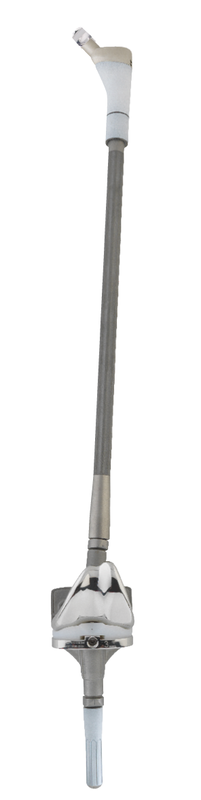
MUTARS® intramedullary total femur replacement with GenuX® MK
The MUTARS® intramedullary total femur replacement with GenuX® MK provides an advanced solution as a so-called through-stem prosthesis, connecting the proximal and distal femur. Developed for the combined revision of the hip and knee joints, this system enables precise adaptation and optimal functionality.
The intramedullary connecting module is fully compatible with all MUTARS® implants for the proximal and distal femur. The modular system architecture allows for flexible intraoperative adaptation to the patient’s individual anatomical and clinical requirements, thereby supporting precise reconstruction and optimized restoration of function. Another feature is the silver coating, which utilizes the properties of silver in the coated components to reduce the risk of infection and increase the service life of the prosthesis.
The MUTARS® intramedullary total femur replacement with GenuX® MK is also available in an HD version. For more information, please follow this link: HD Focus Page
- revision treatment of the hip and knee joint with intramedullary connection
- fully coupled knee system
- high degree of modularity and compatibility
- fixed-bearing polyethylene inserts and mobile-bearing PE inserts with up to 20° of rotation, available in various heights
- cemented and cementless femoral and tibial components
- cemented and cementless stem options
- 360° freely adjustable offset
- femoral and tibial spacer fixation
- EPORE® Cones, EPORE® metaphyseal components
- compatible with cemented MUTARS® patellar resurfacing components
- implatan®; TiAl6V4 according to ISO 5832-3 (MUTARS® RS proximal component, MUTARS® RS metaphyseal component, MUTARS® RS extension piece, MUTARS® RS screws, MUTARS® intramedullary connecting modules, MUTARS® GenuX® MK offset adapters, MK spacers, cementless MUTARS® GenuX® MK stems)
- implavit®; CoCrMo according to ISO 5832-4 (MUTARS® GenuX® MK femoral and tibia components, cemented MUTARS® GenuX® MK stems)
- implavit®; CoCrMo according to ISO 5832-12 (MUTARS® coupling)
- UHMWPE according to ISO 5834-2 and implacross® E; cross-linked UHMWPE with vitamin E (MUTARS® GenuX® MK PE inserts)
- TiN coating (optional for MUTARS® GenuX® MK femoral and tibial components, MUTARS® GenuX® MK cemented stems)
- TiNbN coating (optional for MUTARS® coupling)
- implaFix® HA; HA coating according to ISO 13779-2 (optional for cementless MUTARS® GenuX® MK stems, MUTARS® RS extension piece and MUTARS® RS metaphyseal component)
- silver coating (optional for MUTARS® RS proximal component, MUTARS® intramedullary connecting modules and MK spacer)
- ic heads
- 4 MUTARS® RS proximal components
- length: 32 mm and 42 mm
- CCD angle: 127° / 135°
- 4 MUTARS® RS metaphyseal components
- length: 40 mm and 50 mm
- size: standard / slim
- MUTARS® RS extension piece 25 mm
- MUTARS® intramedullary connecting module for GenuX® MK femur
- lenght: 120 mm – 440 mm
- diameter: 15 mm
- 5 MUTARS® GenuX® MK femur and tibia components: sz. 2 – 6
- 3 options of MUTARS® coupling: 12.5 mm, 15 mm and 17.5 mm
- 3 heigths of MUTARS® GenuX® MK PE inserts: 12.5 mm, 15 mm and 17.5 mm
- MK femoral and tibial spacer
- 4 MUTARS® GenuX® MK offset adapter options: 0 mm, 2 mm, 4 mm and 6 mm
- MUTARS® GenuX® MK stems
- MUTARS® patellar replacement
- reconstruction length ≥ 332 mm (femur length)
- taper 12 / 14 mm: combinable with ic-heads S-XXXL (Please refer to the Instruction for Use for restrictions)
- CE Marking
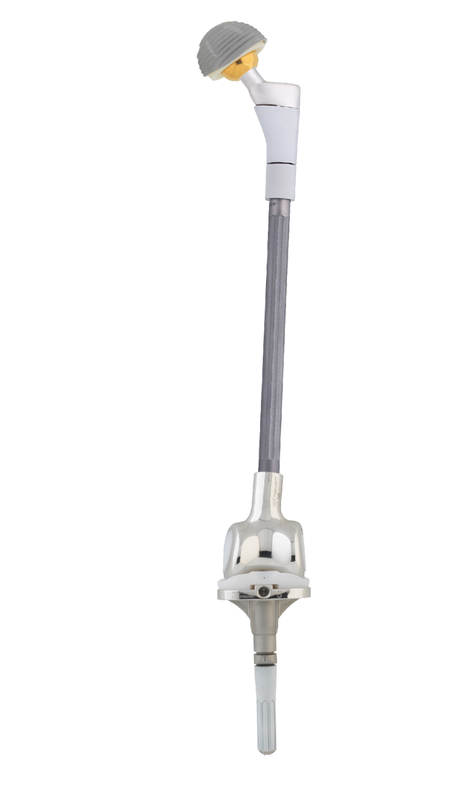
MUTARS® intramedullary total femur replacement with MK KRI
The MUTARS® intramedullary total femur replacement with MK KRI provides an advanced solution for combined hip and knee revision procedures. Designed for the replacement of the distal femur, particularly in cases involving the loss of the distal femoral condyles, this system enables precise adaptation and optimal functionality.
The modular system design enables tailored adaptation to a wide range of anatomical situations. In addition, the system is optionally available with a silver coating, which helps reduce the risk of periprosthetic infections and support the long-term functionality of the implant reconstruction.
The MUTARS® intramedullary total femur replacement with MK KRI is also aviable in an HD version. For more information, please follow this link: HD Focus Page
- revision treatment of the hip and knee joint with intramedullary connection in cases of distal femoral condyle loss
- fully coupled knee system
- high degree of modularity and compatibility
- fixed-bearing polyethylene inserts and mobile-bearing PE inserts with up to 20° of rotation, available in various heights
- cemented and cementless tibial components
- cemented and cementless stem options
- 360° freely adjustable offset
- tibial spacer fixation
- EPORE® Cones and EPORE® metaphyseal components
- compatible with cemented MUTARS® patellar resurfacing components
- implatan®; TiAl6V4 according to ISO 5832-3 (cementless MUTARS® GenuX® MK stems, MUTARS® GenuX® MK offset adapter, MK spacers, MUTARS® RS screws, MUTARS® RS proximal component, MUTARS® RS metaphyseal component, MUTARS® intramedullary connection modules)
- implavit®; CoCrMo according to ISO 5832-4 (cemented MUTARS® GenuX® MK stems, MUTARS® MOM KRI, MUTARS® GenuX® MK tibia)
- implavit®; CoCrMo according to ISO 5832-12 (MUTARS® coupling)
- UHMWPE according to ISO 5834-2 and implacross® E; cross-linked UHMWPE with vitamin E (MUTARS® GenuX® MK PE inserts)
- TiN coating (optional for femoral and tibial components, cemented MUTARS® GenuX® MK stems)
- TiNbN coating (optional for MUTARS® coupling)
- implaFix® HA; HA coating according to ISO 13779-2 (optional for cementless MUTARS® GenuX® MK stems, MUTARS® RS extension piece and MUTARS® RS metaphyseal component)
- silver TiN coating (optional for MUTARS® MOM KRI)
- silver coating (optional for MUTARS® RS proximal component, MUTARS® intramedullary connecting modules and MK spacer)
- ic heads
- 4 MUTARS® RS proximal component
- length: 32 mm and 42 mm
- CCD angle: 127° / 135°
- 4 MUTARS® RS metaphyseal component
- length: 40 mm and 50 mm
- size: standard / slim
- MUTARS® RS extension piece
- MUTARS® intramedullary connecting module for KRI
- lenght: 100 mm – 360 mm
- diameter: 15 mm
- MUTARS® MOM KRI
- 3 options of MUTARS® coupling: 12.5 mm, 15 mm and 17.5 mm
- 3 heights of MUTARS® GenuX® MK PE inserts: 12.5 mm, 15 mm and 17.5 mm
- 5 MUTARS® GenuX® MK tibial components: sz. 2 – 6
- 4 MUTARS® GenuX® MK offset options: 0 mm, 2 mm, 4 mm and 6 mm
- MUTARS® GenuX® MK stems
- MK tibial spacer
- MUTARS® patella replacement
- reconstruction length ≥ 332 mm (femur length)
- taper 12 / 14 mm: combinable with ic-heads S-XXXL (Please refer to the Instruction for Use for restrictions)
- CE Marking
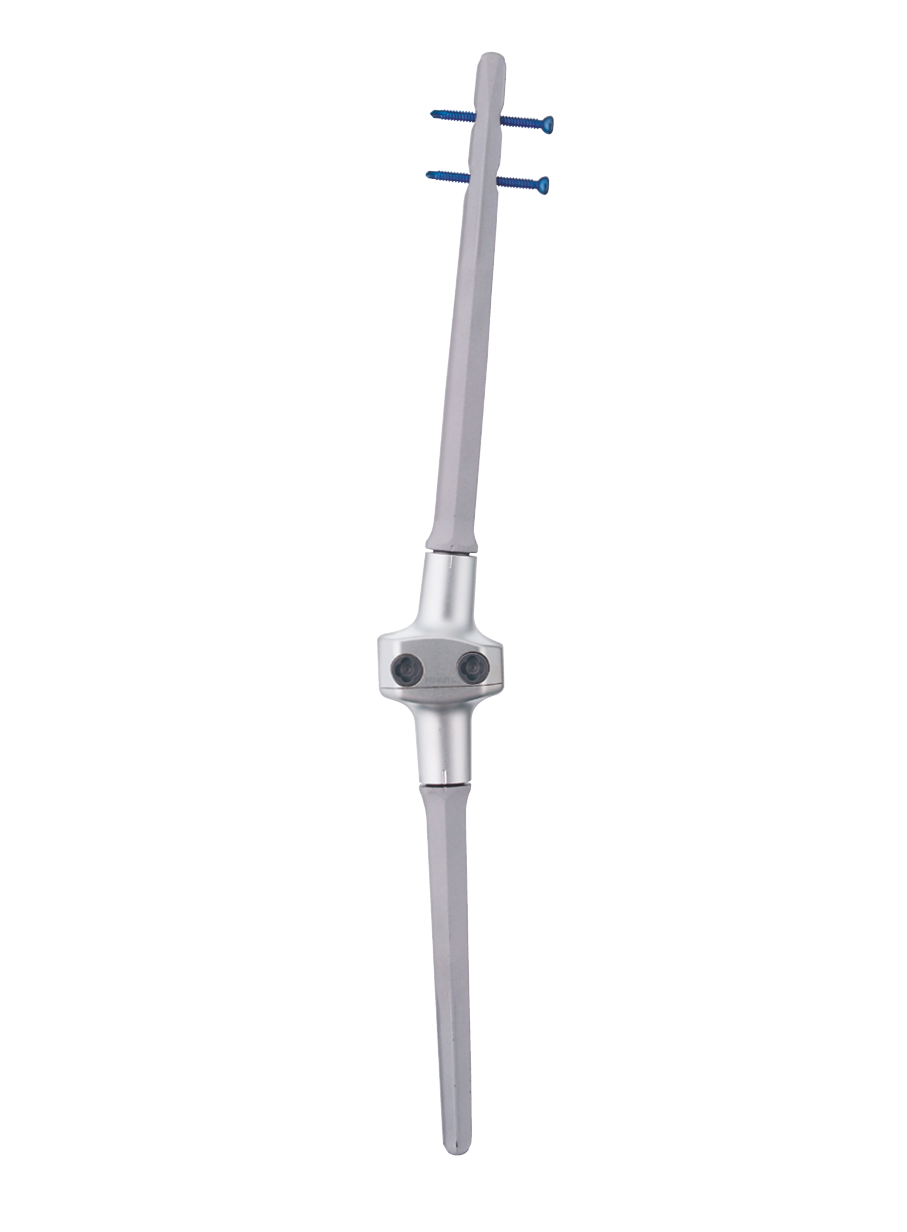
MUTARS® RS Arthrodesis
The MUTARS® RS Arthrodesis provides a solution for knee joint fusion in cases of extensive bone loss and compromised soft tissue conditions. The broad portfolio of RS stems supports individualized treatment across different bone qualities. In addition, EPORE® Cones enable the reconstruction and bridging of larger bone defects on both the tibial and femoral sides.
The MUTARS® RS Arthrodesis System consists of a femoral and a tibial component. The femoral component is side-specific, as it incorporates a natural valgus alignment. The arthrodesis components are designed without an intrinsic flexion angle. Flexion positioning is achieved by means of the curved tibial RS stem. Another important feature is the silver coating. The antimicrobial properties of silver are utilized to support infection prevention and potentially improve long-term implant survivorship.
- revision cases involving the knee joint with loss of the extensor mechanism
- reconstruction length individually adjustable between 30 mm and 90 mm
- cemented and cementless stem options
- EPORE® Cones
- implatan®; TiAl6V4 according to ISO 5832-3 (MUTARS® femoral and tibial component, MUTARS® RS extension piece, cementless stems)
- implavit®; CoCrMo according to ISO 5832-4 (cemented stems)
- silver coating (optional for MUTARS® femoral and tibial component)
- TiN coating (optional for cemented stems)
- implaFix® HA; HA coating according to ISO 13779-2 (optional for MUTARS® RS extensions piece and cementless stems)
- 31 MUTARS® RS stems cementless
- length: 150 mm, 200 mm and 250 mm
- Ø 12 – 22 mm (in 1 mm steps) for lengths 150 mm and 200 mm
- Ø 14 – 22 mm (in 1 mm steps) for length 250 mm
- 12 MUTARS® RS stems cemented
- length: 120 mm, 150 mm and 200 mm
- Ø 12 – 18 mm (in 2 mm steps)
- MUTARS® RS extension piece 25 mm
- MUTARS® RS arthrodesis implant femoral component
- MUTARS® RS arthrodesis implant tibial component
- reconstruction lenght ≤ 90 mm (30 mm when the stem connection parts are recessed into the bone)
- CE Marking
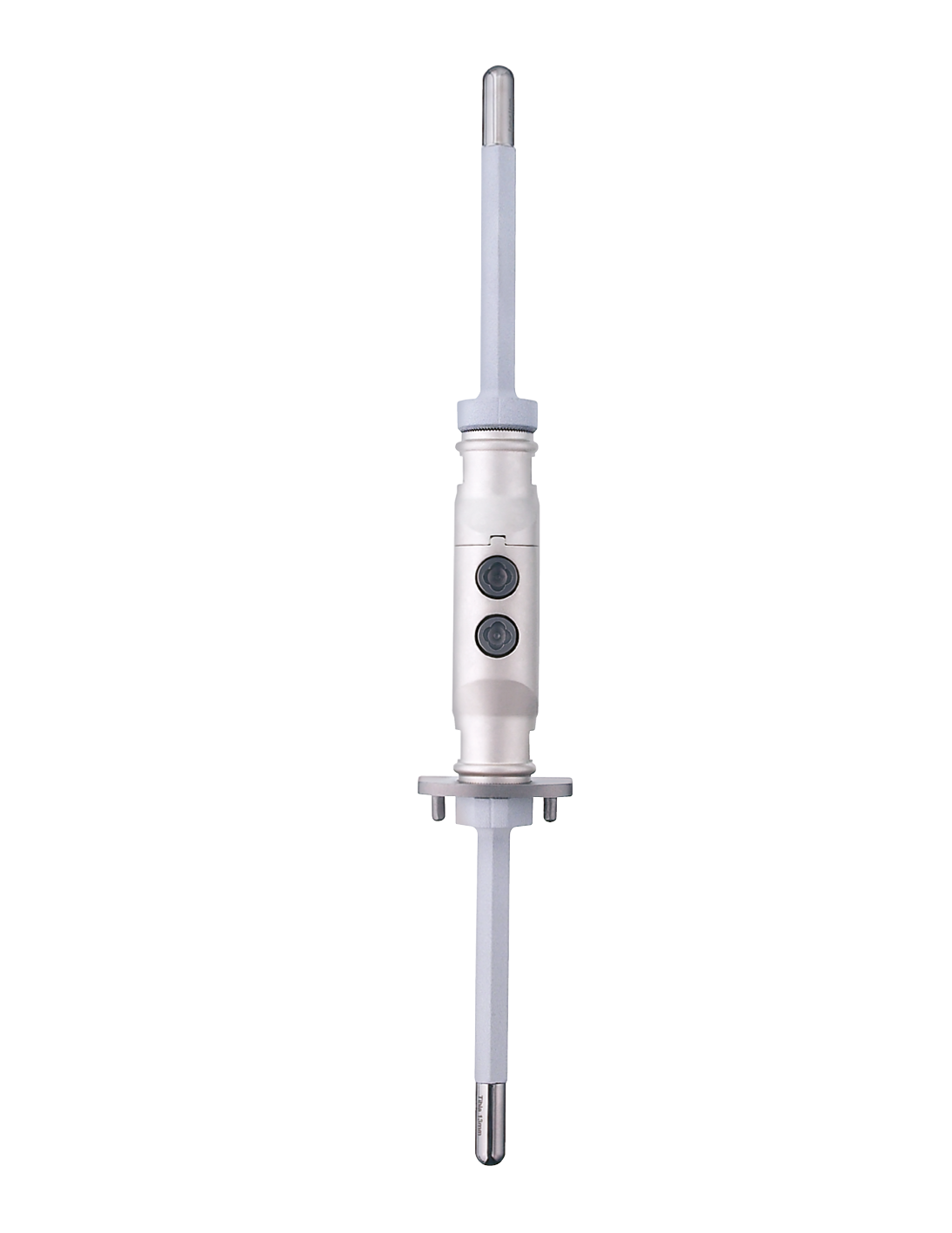
MUTARS® Arthrodesis
The MUTARS® Arthrodesis is a modular reconstruction solution for knee joint fusion, mainly used in cases of massive bone loss of the femur and tibia combined with compromised soft tissue conditions.
The arthrodesis nail enables limb preservation even in the presence of severe defects, allowing patients to maintain independence and mobility.
The MUTARS® Arthrodesis can be used in combination with a tibial plate to prevent subsidence of the implant into the tibial bone in cases where only minimal tibial resection has been performed. The tibial plate is placed between the MUTARS® stem and the MUTARS® Arthrodesis.
Another important feature is the silver coating. The antimicrobial properties of silver are utilized to support infection prevention and potentially improve long-term implant survivorship.
- revision and tumor cases involving the knee joint with loss of the extensor mechanism
- extendable in 20 mm increments (for reconstruction lengths of 185 mm or greater)
- cemented and cementless MUTARS® stems
- 5° rotational adjustment of the component after stem implantation
- MUTARS® fit
- implatan®; TiAl6V4 according to ISO 5832-3 (MUTARS® arthrodesis implant, MUTARS® extension pieces, MUTARS® screws, cementless MUTARS® femoral and tibial stems)
- implavit®; CoCrMo according to ISO 5832-4 (MUTARS® tibial plate, cemented MUTARS® femoral and tibial stems)
- TiN coating (optional for MUTARS® cemented stems, MUTARS® tibial plate)
- implaFix® HA; HA coating according to ISO 13779-2 (cementless MUTARS® stems)
- silver coating (optional for MUTARS® arthrodesis implant, MUTARS® extension pieces)
- MUTARS® femoral and tibial stems
- MUTARS® arthrodesis implant
- 5 MUTARS® extention pieces: 30 mm, 40 mm, 60 mm, 80 mm and 100 mm
- MUTARS® tibial plate
- rekonstruktion length ≥ 145 mm
- CE Marking
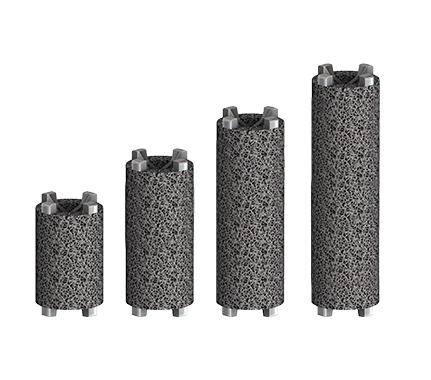
EPORE® diaphyseal implant
The state-of-the-art EPORE® diaphyseal implant is a fully additively manufactured implant system designed for the treatment of bone defects of various etiologies in the diaphyseal regions of the femur, tibia, and humerus. Implantation in combination with a standard intramedullary nail is easy to learn and requires only a limited number of instruments in the operating room.
EPORE® was developed to achieve high porosity combined with a low modulus of elasticity. The material closely mimics the structure of natural bone, thereby promoting bone ingrowth into the implant and supporting biological integration.
- fractures or comminuted fractures in the diaphysis of the femur, tibia, and humerus
- metastasis-related bone loss in the diaphysis of the femur, tibia, and humerus
- traumatic bone defects where an external fixator is not indicated for medical reasons
- one-piece implant system
- can be combined with commercially available intramedullary nails
- EPORE®; TiAl6V4: EPORE® diaphyseal implant
- EPORE® diaphyseal implant
- reconstruction length: 40 mm – 100 mm
- diameter: 28 mm – 34 mm
- inner diameter: 15.5 mm
- CE Marking
Tumour endoprosthetics
MUTARS® distal femur MK
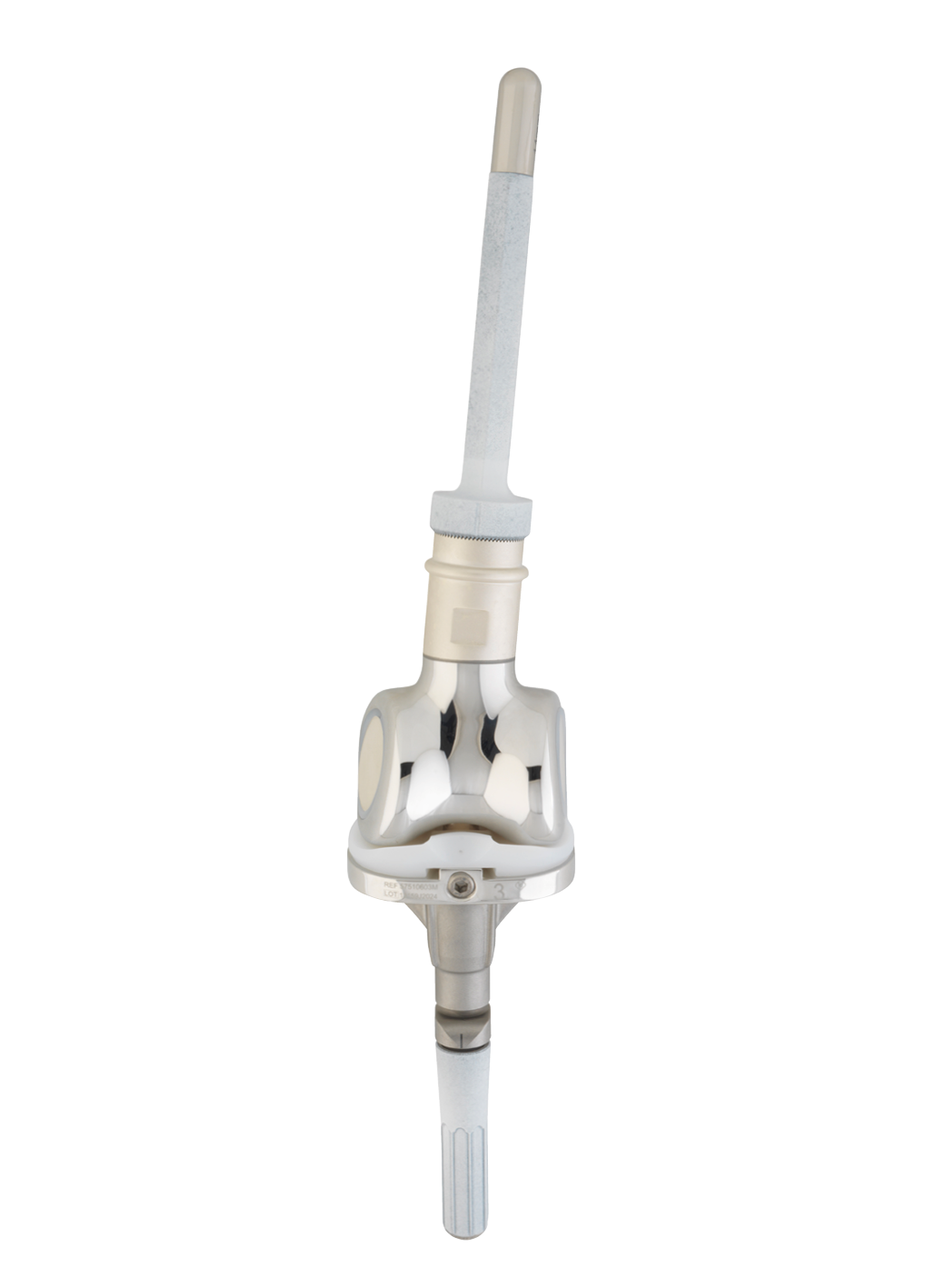
The MUTARS® distal femur MK is a fully coupled knee system developed for the replacement of the distal femur and metaphysis, with the option to extend reconstruction into the diaphysis using modular extension pieces. It is particularly suited for limb-salvage procedures in patients with bone sarcomas and extensive bone loss. The curved femur stems are designed to match the natural anatomy of the femur, supporting optimal implant positioning and fixation within the femoral canal. Multiple femoral component sizes allow for patient-specific anatomical reconstruction.
The biomechanically optimized coupling between the femoral and tibial components provides multidirectional stability while maintaining a range of motion of up to 130° of knee flexion.
The system is modular and can be expanded to a total knee replacement or even a total femur replacement, providing exceptional versatility for complex reconstructive procedures. Furthermore, femoral RS stems can be incorporated via a dedicated coupling component, offering additional flexibility to accommodate challenging anatomical and clinical situations.The system is also available with an optional TiN coating. This ceramic coating enhances the wettability of the components while minimizing ion release. Another key feature is the silver coating. The properties of silver are utilized in the coated components to help reduce the risk of infection and increase the longevity of the prosthesis.
- tumors of the distal femur
- revision procedures involving extensive bone defects
- fully coupled knee system
- high degree of modularity and compatibility
- rotational adjustment in 5° increments
- reconstruction length can be individually adjusted using extension pieces and the connecting piece
- simplified revision procedures through the use of the connecting piece
- fixed-bearing PE inserts and mobile-bearing PE inserts with up to 20° of rotation, available in various heights
- cemented and cementless tibial components
- cemented, cementless, and modular stem options
- 360° freely adjustable tibial offset
- tibial spacer fixation
- EPORE® Cones and tibial metaphyseal components
- soft tissue reattachment possible using the attachment tube
- compatible with cemented MUTARS® patella
- implatan®; TiAl6V4 according to ISO 5832-3 (MUTARS® exctension piece, MUTARS® connecting piece, cementless stems, MUTARS® GenuX® MK offset adapter)
- implavit®; CoCrMo according to ISO 5832-4 (MUTARS® MOM distal femur, cemented stems, MUTARS® GenuX® MK tibia)
- implavit®; CoCrMo according to ISO 5832-12 (MUTARS® coupling)
- UHMWPE according to ISO 5834-2, implacross® E; cross linked UHMWPE with vitamin E (MUTARS® GenuX® MK PE-inserts)
- silver coating (optional for MUTARS® MOM distal femur, MUTARS® exctension pieces, MUTARS® connecting piece)
- TiN coating (optional for MUTARS® MOM distal femur, cemented stems)
- TiNbN coating (optinal for MUTARS® coupling)
- implaFix® HA; HA coating acc. to ISO 13779-2 (optional for cementless stems)
- MUTARS® femoral stems
- 5 MUTARS® extension pieces: 30 mm, 40 mm, 60 mm, 80 mm and 100 mm
- MUTARS® conneting piece 100 mm
- 2 lengths of MUTARS® MOM distal femur: 90 mm and 110 mm
- 3 options of the MUTARS® coupling: 12.5 mm, 15 mm and 17.5 mm
- 3 heights of the MUTARS® GenuX® MK PE inserts: 12.5 mm, 15 mm and 17.5 mm
- 5 MUTARS® GenuX® MK femoral components: sz. 2 – 6
- MUTARS® GenuX® MK stems
- reconstruction length ≥ 100 mm
- CE Marking
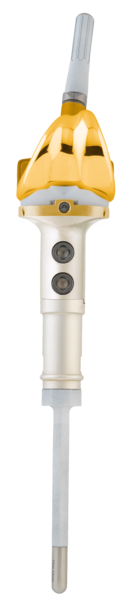
MUTARS® MK proximal tibia
The MUTARS® MK proximal tibia offers provides a solution for reconstructive knee surgery in patients with tumors located in the proximal tibia.
Diaphyseal fixation combined with the modular design allows for anatomical adaptation and a high level of functional stability. The individual system components can be configured flexibly, enabling customized reconstruction tailored to the anatomical and clinical requirements of each patient. Another key feature is the silver coating. The properties of silver are utilized in the coated components to help reduce the risk of infection and increase the longevity of the prosthesis.
In addition, the MUTARS® MK proximal tibia is available in a HD version. For more information, please follow this link: HD Focus Page
- tumors in the proximal tibia
- extensive revisions in the proximal tibia with reconstruction of the tibial bone
- fully coupled knee system
- high degree of modularity and compatibility
- fixed-bearing polyethylene inserts and mobile-bearing PE inserts with up to 20° of rotation, available in various heights
- 5 femoral sizes and 2 tibial lengths
- cemented and cementless femoral components
- cemented and cementless stem options
- rotational adjustment in 5° increments
- 360° freely adjustable offset
- femoral spacer fixation
- EPORE® Cones and EPORE® metaphyseal components
- compatible with cemented MUTARS® patellar resurfacing components
- implatan®; TiAl6V4 according to ISO 5832-3 (MUTARS® proximal tibial component, MUTARS® extension pieces, MUTARS® connecting part, MUTARS® screws, MK spacers, MUTARS® GenuX® MK offset adapters, cementless stems)
- implavit®; CoCrMo according to ISO 5832-4 (MUTARS® GenuX® MK femur, MUTARS® MK proximal tibia, cemented stems)
- implavit®; CoCrMo nach ISO 5832-12 (MUTARS® coupling)
- inserts: UHMWPE according to ISO 5834-2 and implacross® E; cross-linked UHMWPE with vitamin E (MUTARS® GenuX® MK PE inserts)
- TiN coating (optional for MUTARS® GenuX® MK femur components, cemented stems)
- TiNbN coating (optional for MUTARS® coupling)
- implaFix® HA; HA coating according to ISO 13779-2 (optimal for cementless stems)
- silver coating (optional for MUTARS® proximal tibial component, MUTARS® extension pieces, MUTARS® connecting part and MK spacer)
- MUTARS® GenuX® MK stems
- 4 MUTARS® GenuX® MK Offset options: 0 mm, 2 mm, 4 mm and 6 mm
- 5 MUTARS® GenuX® MK femoral components: sz. 2 – 6
- MK femoral spacer
- 3 options MUTARS® GenuX® MK PE insert sz. 2: 12.5 mm, 15 mm and 17.5 mm
- 3 length of MUTARS® coupling: 12.5 mm, 15 mm and 17.5 mm
- MUTARS® proximal tibia
- MUTARS® connecting part for proximal tibia: 105 mm and 125 mm
- MUTARS® tibial stems: cemented and cementless
- MUTARS® cemented patella surface replacement
- reconstruction length ≥ 115 mm
- CE Marking
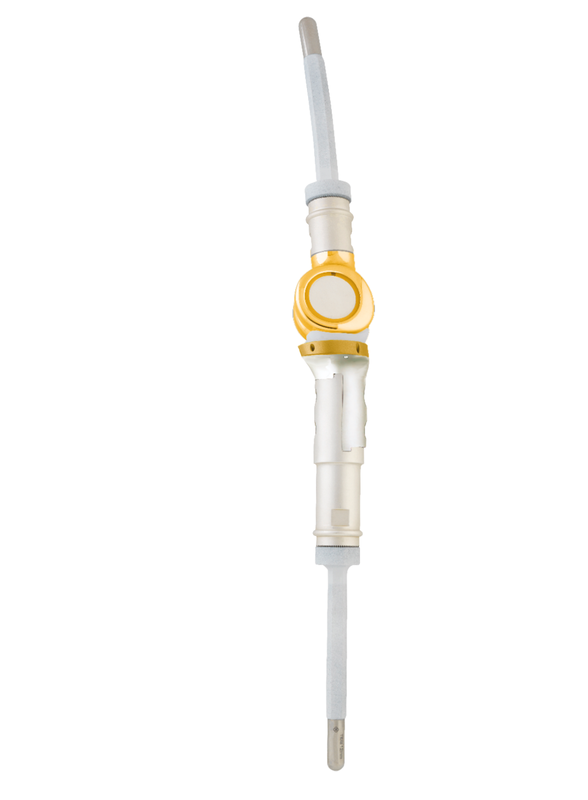
MUTARS® MK total knee
The MUTARS® MK total knee is a fully coupled endoprosthetic system that provides a reliable solution for complete knee joint replacement in complex clinical indications. The reconstruction is based on a proximal tibia replacement, which can be flexibly combined with both the MUTARS® distal femur and the MUTARS® KRI.
The high degree of component compatibility provides the surgeon with maximum flexibility and supports a stable, functional reconstruction of the knee joint. The implant configuration can be optimally tailored to the individual anatomical and clinical requirements of each patient. Another key feature is the silver coating. The properties of silver are utilized in the coated components to help reduce the risk of infection and increase the longevity of the prosthesis. The system is also available with an optional TiN coating. This ceramic coating improves the wettability of the components while minimizing ion release.
In addition, the MUTARS® MK total knee is available in an HD version. For more information, please follow this link: HD Focus Page
- tumors involving the knee joint with extensive femoral and tibial bone defects requiring a coupled knee replacement
- fully coupled knee system
- high degree of modularity and compatibility
- rotational adjustment in 5° increments
- reconstruction length can be individually adjusted using extension pieces and the connecting piece
- fixed-bearing PE inserts and mobile-bearing PE inserts with up to 20° of rotation, available in various heights
- cemented, cementless, and modular stem options
- soft tissue reattachment possible using the attachment tube
- compatible with MUTARS® patella
- implatan®; TiAl6V4 according to ISO 5832-3 (MUTARS® femoral and tibial component, MUTARS® extension pieces, MUTARS® connecting piece, MUTARS® screws, MUTARS® cementless stems)
- implavit®; CoCrMo according to ISO 5832-4 (MUTARS® MOM distal femur, cemented MUTARS® stems)
- implavit®; CoCrMo according to ISO 5832-12 (MUTARS® coupling)
- UHMWPE accordning to ISO 5834-2, implacross® E; cross linked UHMWPE with vitamin E (MUTARS® GenuX® MK PE inserts)
- TiN coating (MUTARS® tibial component and optional for MUTARS® femoral component, cemented MUTARS® stems)
- TiNbN coating (optional for MUTARS® coupling)
- implaFix® HA; HA coating according to ISO 13779-2 (optional for cementless MUTARS® stems)
- silver coating (optional for MUTARS® femoral and tibial component, MUTARS® extension pieces, MUTARS® connecting piece)
- MUTARS® femoral and tibial stems
- 5 MUTARS® extension pieces: 30 mm, 40 mm, 60 mm, 80 mm and 100 mm
- MUTARS® connecting piece 100 mm
- 2 lenghts of MUTARS® MOM distal femur: 90 mm and 110 mm
- 3 options of the MUTARS® coupling: 12.5 mm, 15 mm and 17.5 mm
- 3 height of PE insert Gr. 2: 12.5 mm, 15 mm and 17.5 mm
- MUTARS® proximal tibia
- 2 MUTARS® connecting pieces for proximal tibia: 105 mm, 125 mm
- MUTARS® patella replacement
- reconstruction length
- femoral ≥ 100 mm
- tibial ≥ 115 mm
- CE Marking
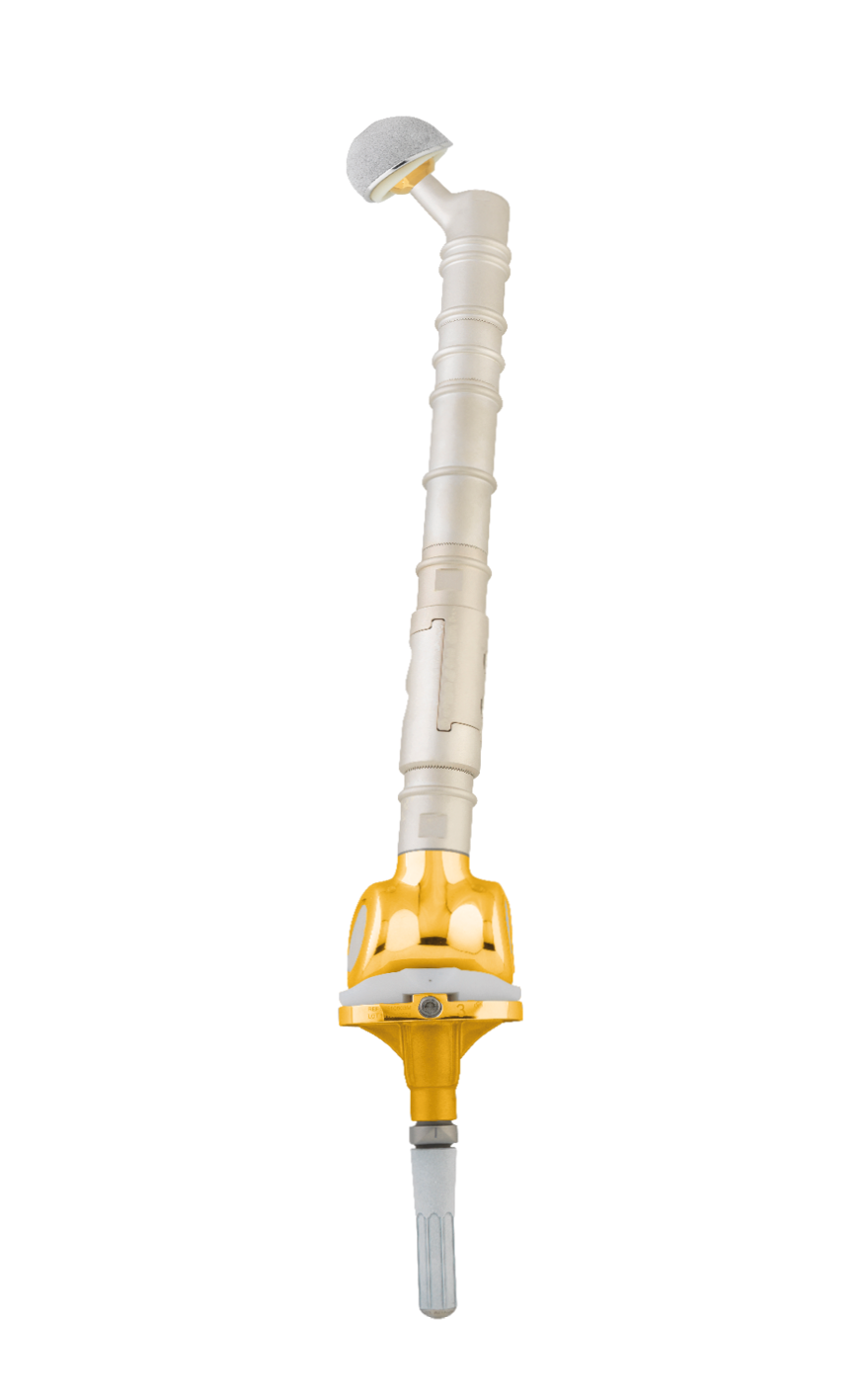
MUTARS® MK total femur
The MUTARS® MK total femur represents a proven solution for the reconstruction of the entire femur in complex clinical indications and is primarily used following extensive tumor resections as well as in challenging defect and revision cases.
Thanks to its modular design, the system enables precise anatomical adaptation while ensuring a high level of mechanical stability. The individual components can be combined flexibly to optimally meet the patient's specific anatomical and clinical requirements. Another key feature is the silver coating. The properties of silver are utilized in the coated components to help reduce the risk of infection and increase the longevity of the prosthesis.
In addition, the MUTARS® MK total femur is also available in an HD version. For more information, please follow this link: HD Focus Page
- revisions of existing prostheses
- tumors in the entire femur with replacement of the hip and knee joint
- fully coupled knee system
- high degree of modularity and compatibility
- rotational adjustment in 5° increments
- reconstruction length can be individually adjusted using extension pieces and the connecting piece
- 140° CCD angle
- simplified revision procedures through the use of the connecting piece
- fixed-bearing PE inserts and mobile-bearing PE inserts with up to 20° of rotation, available in various heights
- cemented and cementless tibial components
- cemented and cementless stem options
- EPORE® Cones and EPORE® metaphyseal components
- soft tissue reattachment possible using the attachment tube
- duo mobility options
- compatible with MUTARS® patella
- implatan®; TiAl6V4 according to ISO 5832-3 (MUTARS® proximal femoral component, MUTARS® extension pieces, MUTARS® connecting part, MUTARS® reducer, MUTARS® screws, MK spacers, MUTARS® GenuX® MK offset adapters, cementless stems)
- implavit®; CoCrMo according to ISO 5832-4 (MUTARS® MOM distal femur, MUTARS® GenuX® MK tibia, cemented stems)
- implavit®; CoCrMo nach ISO 5832-12 (MUTARS® coupling)
- UHMWPE according to ISO 5834-2 and implacross® E; cross-linked UHMWPE with vitamin E (MUTARS® GenuX® MK PE inserts)
- TiN coating (optional for MUTARS® MOM distal femur, MUTARS® GenuX® MK tibia, cemented stems)
- TiNbN coating (optional for MUTARS® coupling)
- implaFix® HA; HA coating according to ISO 13779-2 (optimal for cementless stems)
- silver coating (optional for MUTARS® femoral components, MUTARS® extention pieces, MUTARS® connecting part, MUTARS® reducer, MK spacer)
- silver TiN coating (optional for MUTARS® MOM distal femur)
- 2 MUTARS® proximal femur: 50 mm and 70 mm
- 2 MUTARS® reducer: 20 mm und 30 mm
- 5 MUTARS® extention pieces: 30 mm, 40 mm, 60 mm, 80 mm and 100 mm
- MUTARS® connecting part 100 mm
- 2 sizes MUTARS® MOM distal femur: 90 mm and 110 mm
- 3 heights of MUTARS® GenuX® MK PE insert: 12.5 mm, 15 mm and 17.5 mm
- 3 options of MUTARS® coupling: 12.5 mm, 15 mm and 17.5 mm
- 5 MUTARS® GenuX® MK tibial components: sz. 2 – 6
- 4 MUTARS® GenuX® MK offset adapter: 0 mm, 2 mm, 4 mm and 6 mm
- MK spacer
- MUTARS® GenuX® MK stems
- MUTARS® patella replacement
- reconstruction length ≥ 280 mm
- CE Marking
MUTARS® Arthrodesis
The MUTARS® Arthrodesis is a modular reconstruction solution for knee joint fusion, mainly used in cases of massive bone loss of the femur and tibia combined with compromised soft tissue conditions.
The arthrodesis nail enables limb preservation even in the presence of severe defects, allowing patients to maintain independence and mobility.
The MUTARS® Arthrodesis can be used in combination with a tibial plate to prevent subsidence of the implant into the tibial bone in cases where only minimal tibial resection has been performed. The tibial plate is placed between the MUTARS® stem and the MUTARS® Arthrodesis.
Another important feature is the silver coating. The antimicrobial properties of silver are utilized to support infection prevention and potentially improve long-term implant survivorship.
- revision and tumor cases involving the knee joint with loss of the extensor mechanism
- modularity and compatibility within the MUTARS® portfolio
- extendable in 20 mm increments (for reconstruction lengths of 185 mm or greater)
- cemented and cementless stems
- rotational adjustment in 5° increments
- MUTARS® fit
- implatan®; TiAl6V4 acc. to ISO 5832-3 (MUTARS® arthrodesis implant, MUTARS® extension pieces, MUTARS® screws, cementless MUTARS® femoral and tibial stems)
- implavit®; CoCrMo acc. to ISO 5832-4 (MUTARS® tibial plate, cemented MUTARS® femoral and tibial stems)
- TiN coating (optional for cemented MUTARS® stems, MUTARS® tibial plate)
- implaFix® HA; HA coating acc. to ISO 13779-2 (cementless MUTARS® stems)
- silver coating (optional for MUTARS® arthrodesis implant, MUTARS® extension pieces)
- MUTARS® femoral and tibial stems
- MUTARS® arthrodesis implant
- MUTARS® tibial plate
- 5 MUTARS® extention pieces: 30 mm, 40 mm, 60 mm, 80 mm and 100 mm
- reconstruction length ≥ 145 mm
- CE Marking
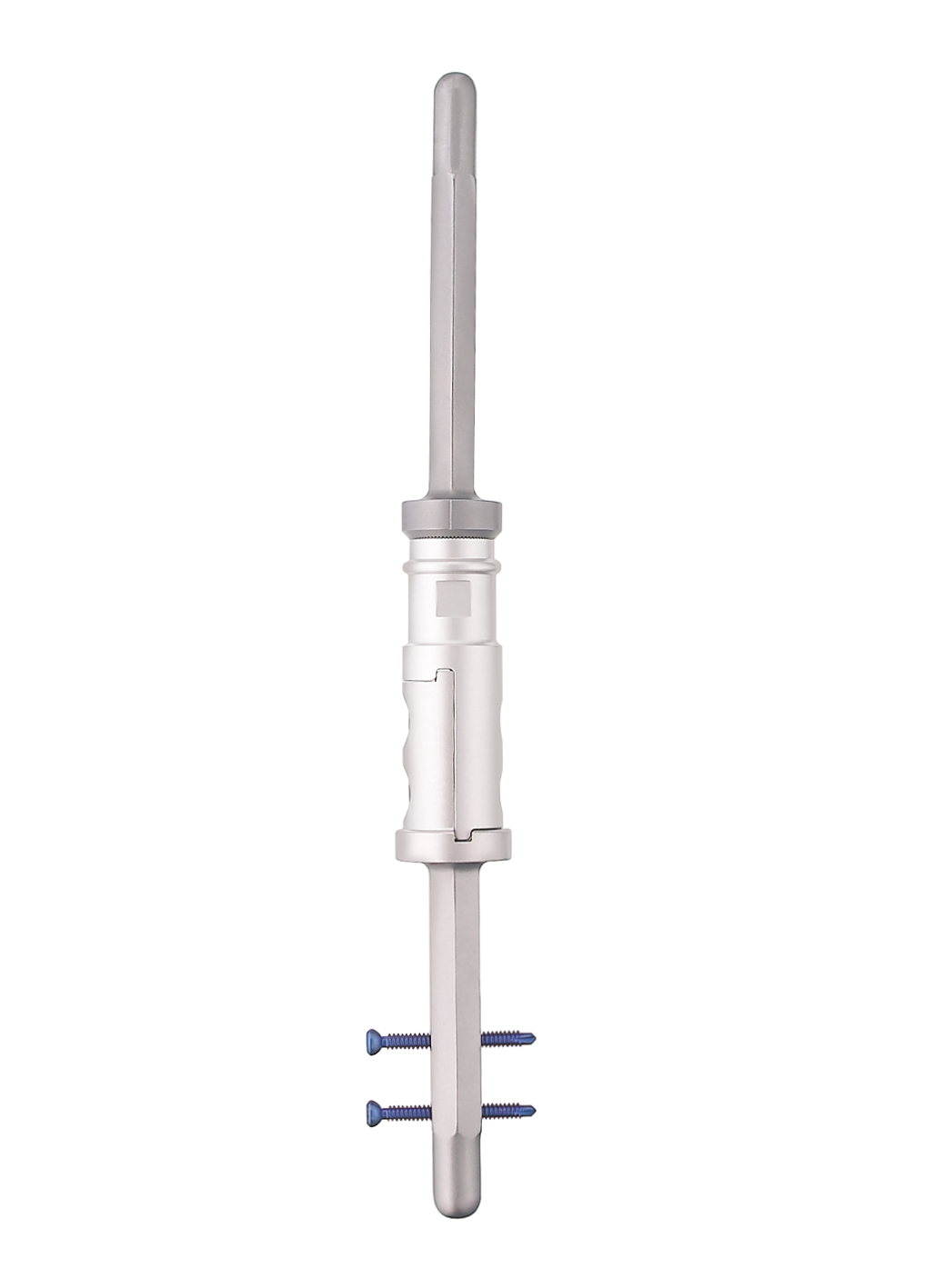
MUTARS® Diaphysis
The MUTARS® Diaphysis is designed for use in the femoral and tibial diaphysis and is indicated for the treatment of diaphyseal bone defects.
The diaphyseal implant is fully compatible with all MUTARS® stems and can be used reliably in both the femur and the tibia. This high degree of compatibility enables individualized, anatomy-based reconstruction in the management of complex clinical cases.
Another important feature is the silver coating. The antimicrobial properties of silver are utilized to support infection prevention and potentially improve long-term implant survivorship.
- reconstruction of femoral and tibial diaphyseal defects resulting from various underlying causes
- high degree of modularity and compatibility
- rotational adjustment in 5° increments
- reconstruction length can be individually adjusted using extension pieces and the connecting piece
- cemented, cementless, and modular femoral stem options
- MUTARS® fit
- implatan®; TiAl6V4 according to ISO 5832-3 (connecting part for MUTARS® diaphyseal imaplant, MUTARS® extension piece, MUTARS® connecting part, MUTARS® screw, cementless MUTARS® femoral stems)
- implavit®; CoCrMo according to ISO 5832-4 (MUTARS® diapyhseal implant, cemented MUTARS® femoral stems)
- TiN coating (optional for cemented MUTARS® femoral stems, MUTARS® diaphyseal implant)
- implaFix® HA; HA coating according to ISO 13779-2 (cementless MUTARS® femoral stems)
- silver coating (optional for MUTARS® diaphyseal implant, connecting part for MUTARS® diaphyseal implant, MUTARS® extension pieces, MUTARS® connecting part)
- MUTARS® diaphyseal implant
- 2 connecting parts for MUTARS® diaphyseal implant: 100 mm and 120 mm
- 5 MUTARS® extension pieces: 30 mm, 40 mm, 60 mm, 80 mm and 100 mm
- MUTARS® connecting part 100 mm
- MUTARS® stem modular straight or curved with EPORE® HA collar
- MUTARS® femoral stems
- reconstruction length ≥ 100 mm
- CE Marking
Cement Spacer and defect fillers
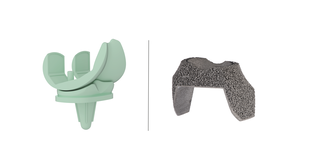
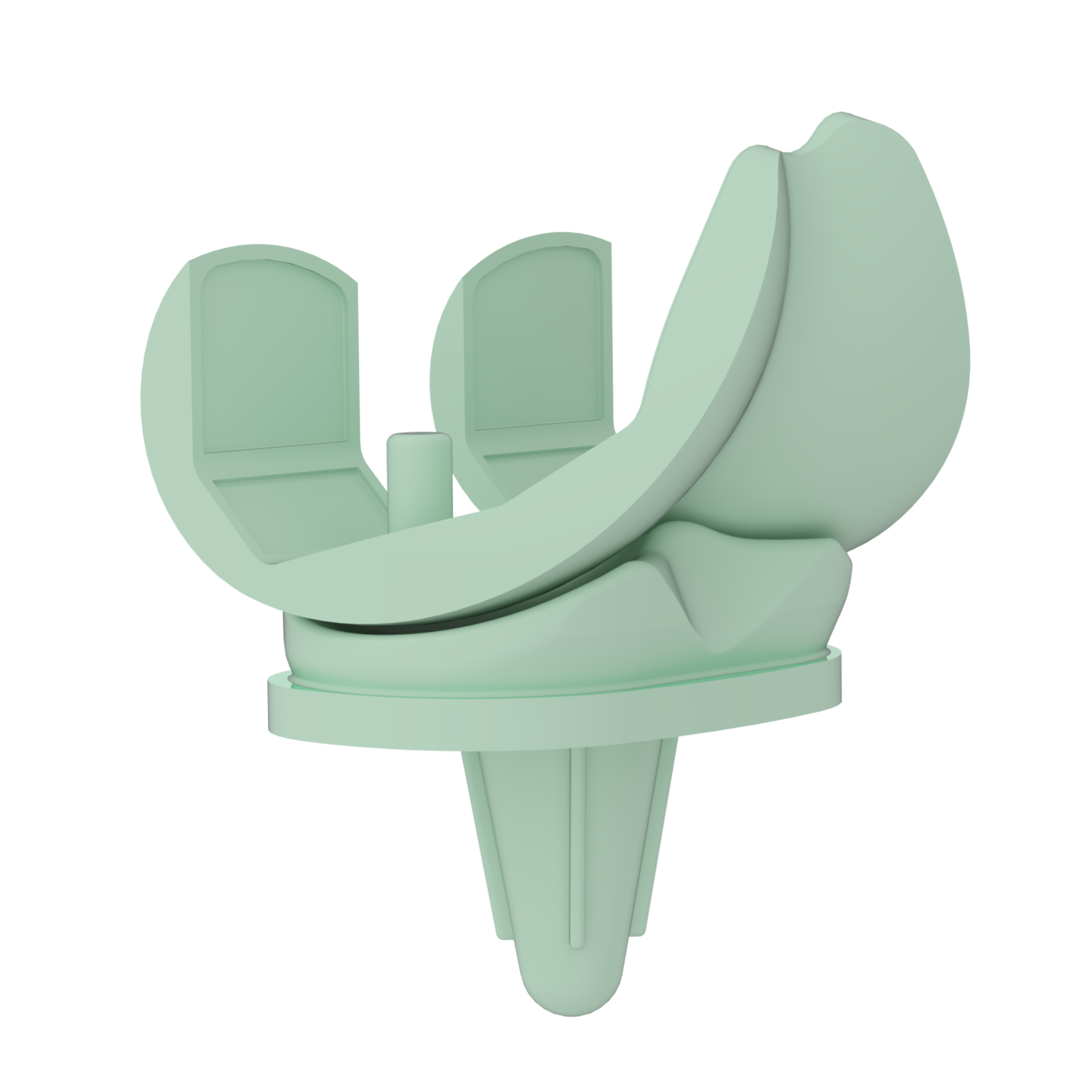
cement spacer
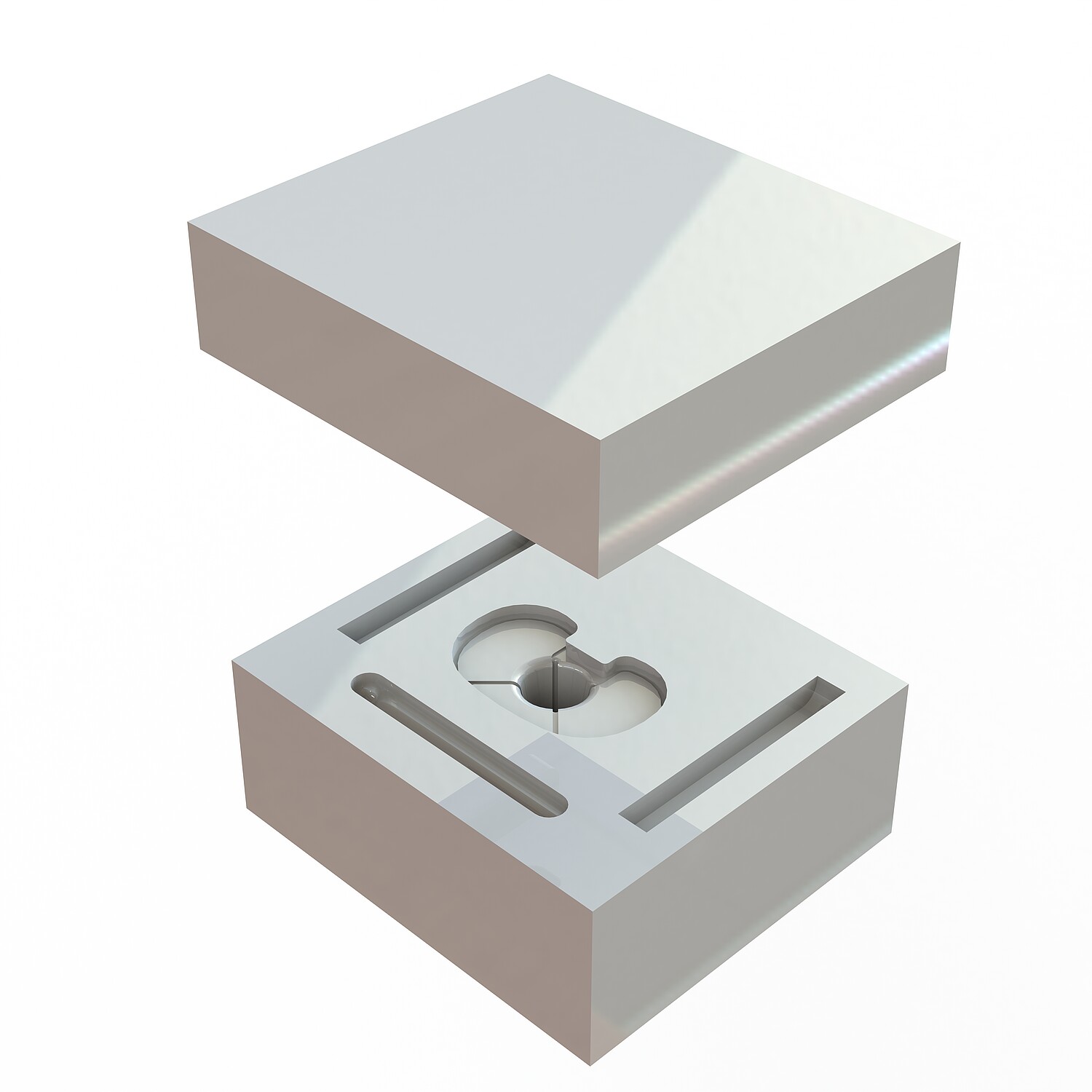
cement spacer molds
ACS® tibia components
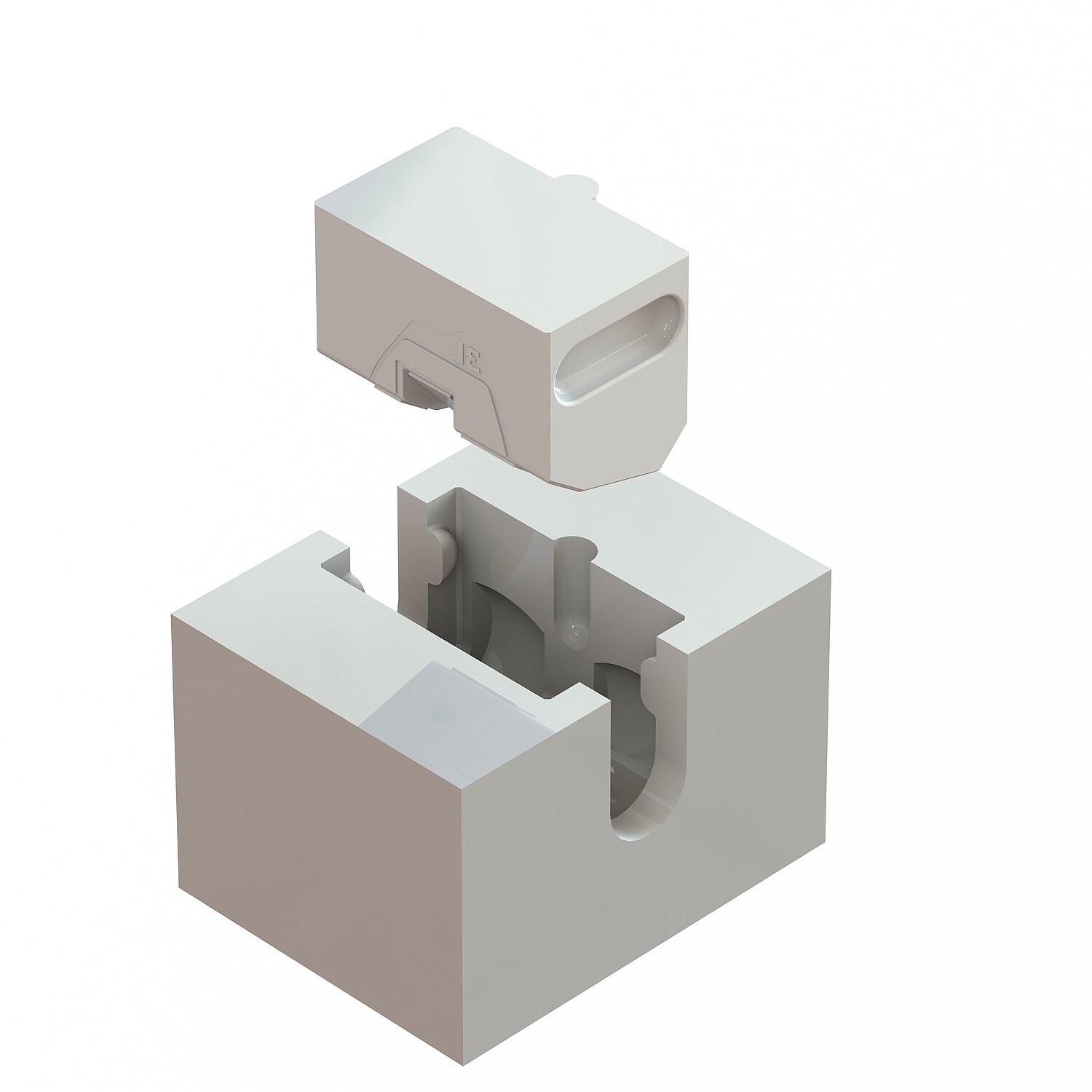
cement spacer molds
ACS® femur components
CEMPADIC® cement spacer molds knee
The two-piece CEMPADIC® spacer molds made of silicone enable the surgeon to create intraoperatively cement spacers from antibiotic-containing cement in the geometry of the ACS® knee prosthesis. This preserves joint mobility and prevents soft tissue contractures.
Individual antibiotic treatment is possible thanks to freely selectable bone cement and antibiotics, adapted to the underlying culture and its sensitivity1),2).
Quelle:
1) doi:10.1002/jor.25570
2) doi: 10.1007/s00064-023-00803-z
- infection-related revision surgery
- maintains joint mobility and prevents soft tissue contractures
- consistent quality and user-friendly application
- re-sterilization possible up to 25 times per CEMPADIC® cement spacer mold
- individual antibiotic treatment with freely selectable bone cement and antibiotics
- silicone
- femoral and tibial sizes 2–5 (femoral available for left and right)
- CE Marking
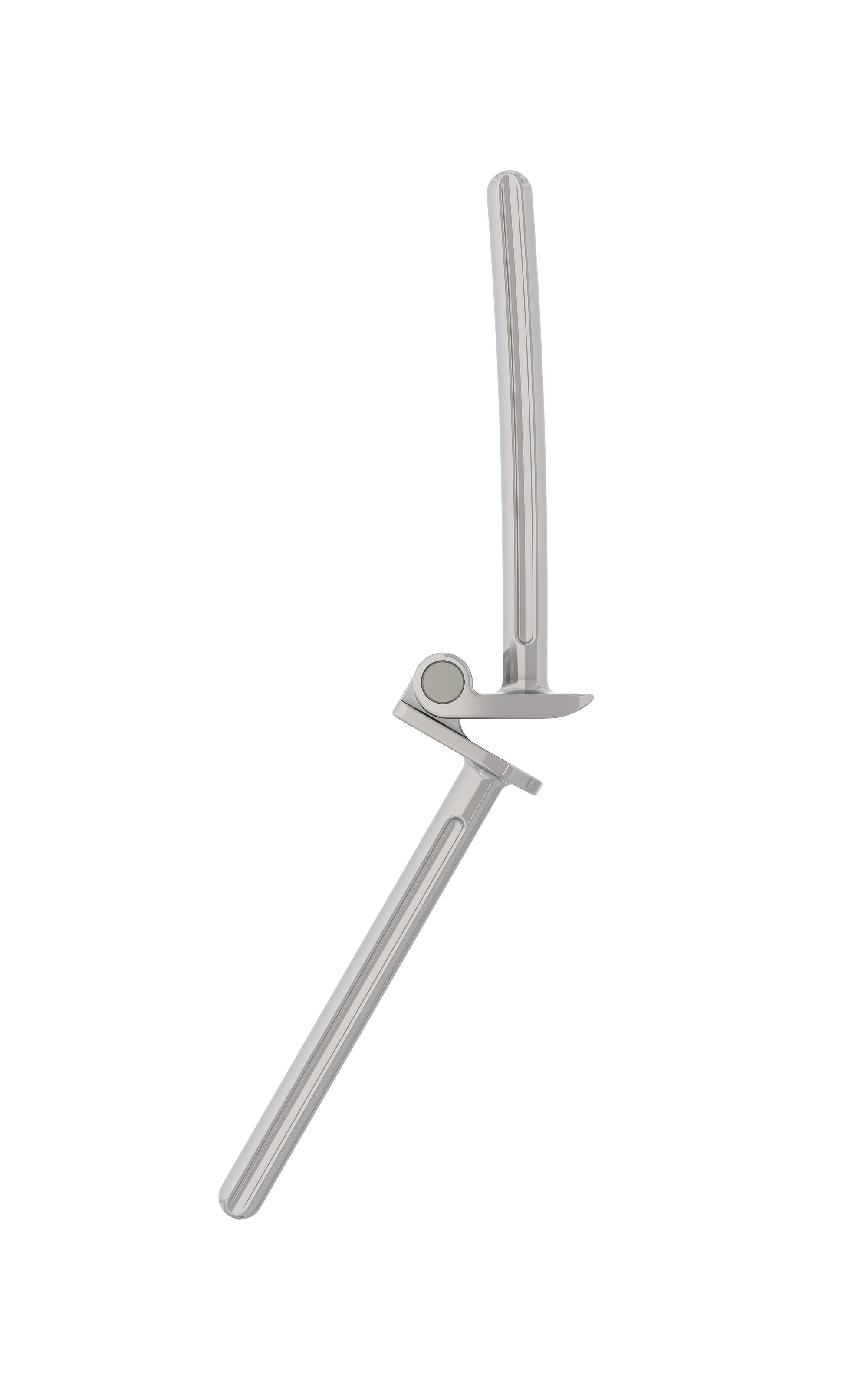
CEMPADIC® HK Spacer Knee
The CEMPADIC® HK (Hinged Knee) Spacer is an axially guided interim prosthesis of which the stems are covered with antibiotic-containing cement during infection treatment. After explantation of the infected prosthesis, it enables stabilization and passive mobilization of the knee joint in cases of existing knee joint instability.
Individual antibiotic treatment is possible thanks to freely selectable bone cement and antibiotics, adapted to the underlying culture and its sensitivity1),2).
Quelle:
1) doi:10.1002/jor.25570
2) doi: 10.1007/s00064-023-00803-z
- Infection-related revision surgery with associated instability
- maintains joint mobility and prevents soft tissue contractures
- range of motion from 0° extension to 100° flexion
- consistent quality and user-friendly application
- individual antibiotic treatment with freely selectable bone cement and antibiotics
- tibial monoblock component with 0° posterior slope
- femoral monoblock component with integrated 6° valgus angle
- Metallic hinge joint without PE components connects femoral and tibial component
- implavit®; CoCrMo according to ISO 5832-4 (femoral and tibial components)
- implavit®; CoCrMo according to ISO 5832-12 (axis)
- implatan®; TiAl6V4 according to ISO 5832-3 (screw)
- femoral component (available in left and right version) with slightly curved stem (length 124 mm; diameter 11 mm)
- tibial component with stem (length 125 mm; diameter 11 mm)
- CE Marking
CEMPADIC® Connector and CEMPADIC® Titanium Bars Knee
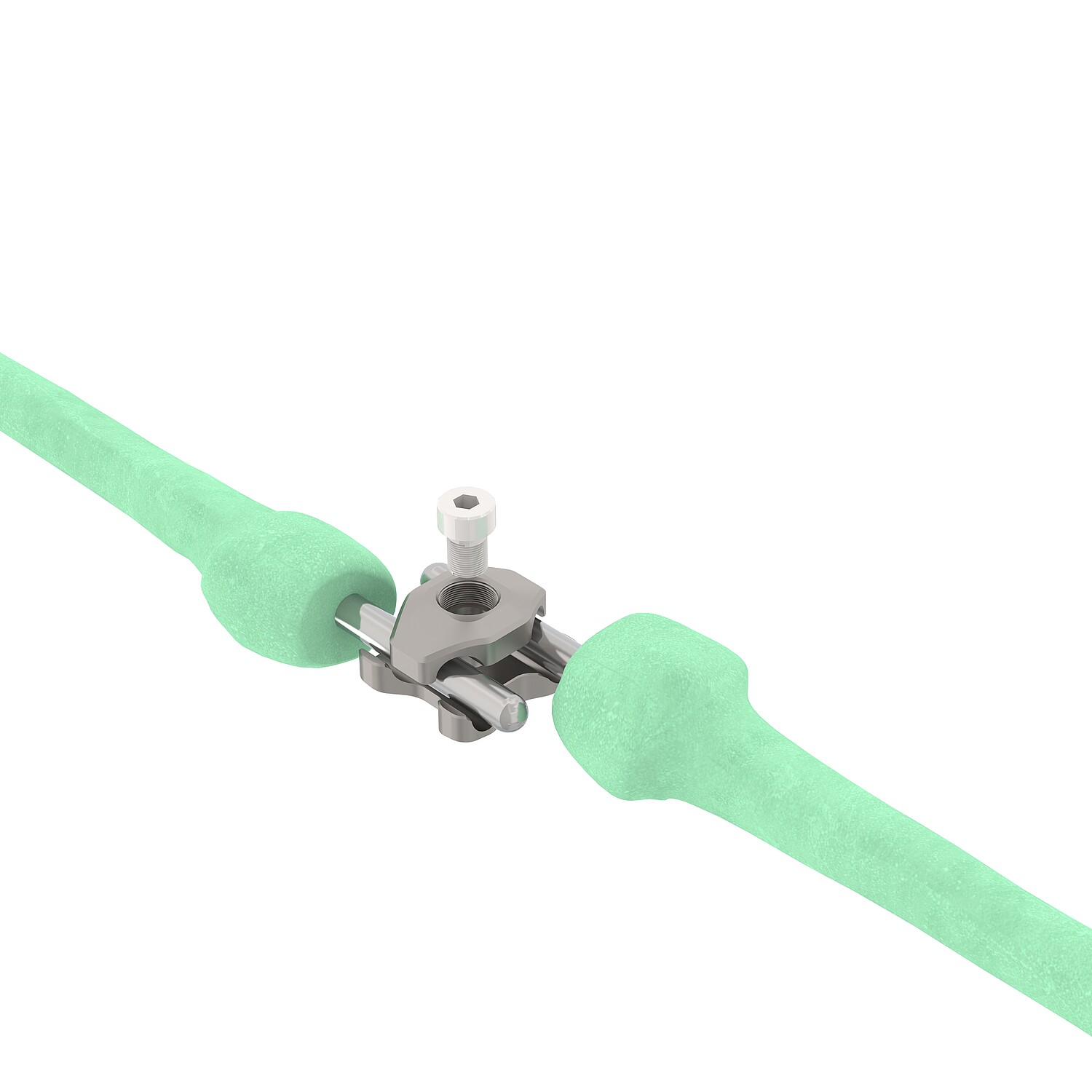
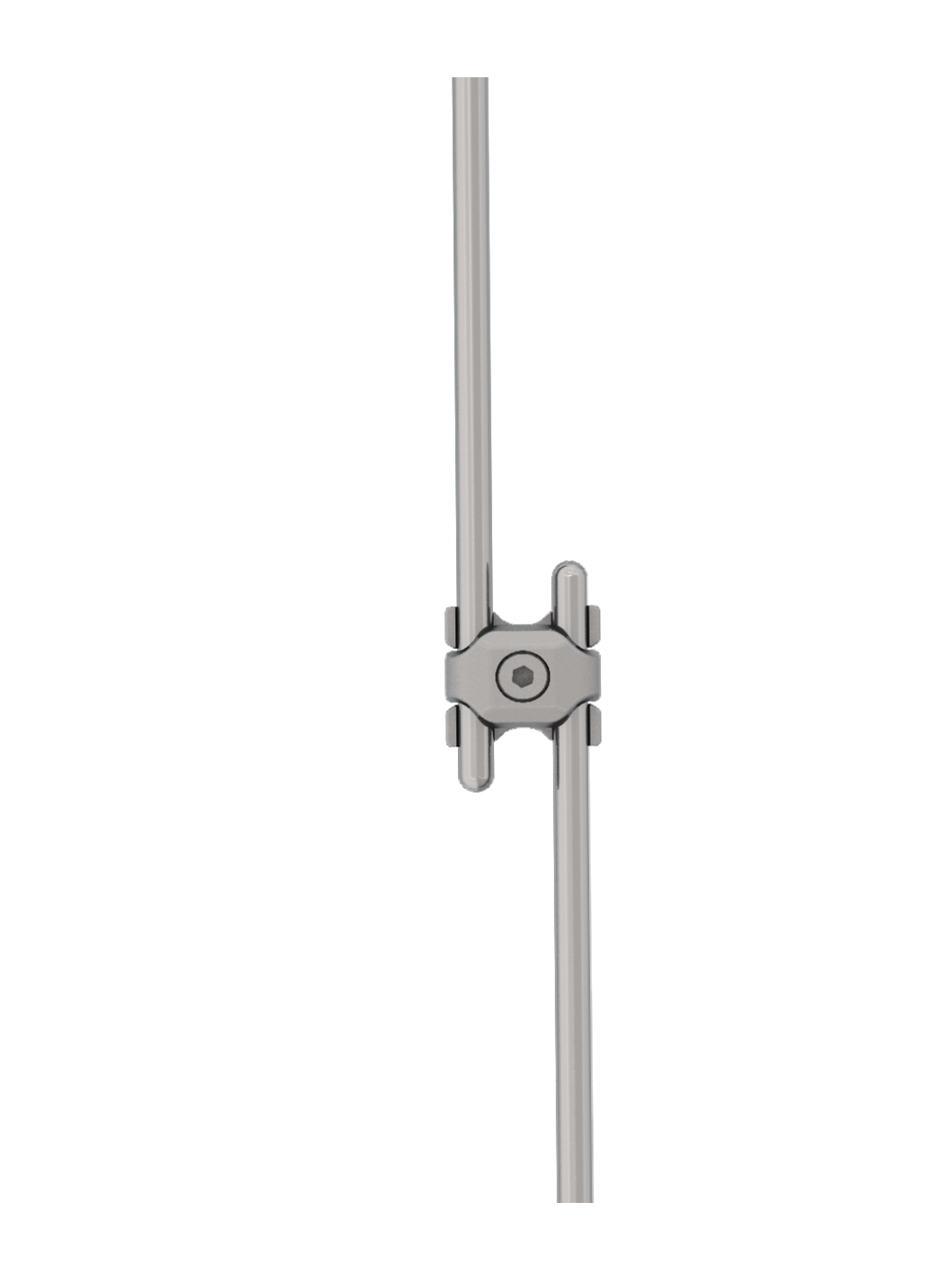
The two-part CEMPADIC® connector was specifically developed to enable the construction of a stable, temporary arthrodesis spacer. Using a screw connection, it creates a rigid structure with CEMPADIC® titanium rods inserted into the femur and tibia and allows for full coverage with antibiotic-containing bone cement.The metal components ensure dimensional stability and secure anchoring.
Individual antibiotic treatment is possible thanks to freely selectable bone cement and antibiotics, adapted to the underlying culture and its sensitivity1),2).
Quelle:
1) doi:10.1002/jor.25570
2) doi: 10.1007/s00064-023-00803-z
- Infection-related revision surgery with knee joint arthrodesis
- specifically developed for use as an arthrodesis spacer
- customizable to the existing bony situation
- user-friendly application and simple installation
- individual antibiotic treatment with freely selectable bone cement and antibiotics
- implatan®; TiAl6V4 to ISO 5832-3 (CEMPADIC® Connector (including screw) and CEMPADIC® titanium bars)
- CEMPADIC® titanium bar available in 3 lengths (length: 320 mm, 360 mm, 400 mm; diameter: 6 mm)
- CEMPADIC® Connector (two-part and including screw) available in 1 size
- CE Marking
ACS® SC MB with EPORE®
cortical cones
EPORE® cortical cones
tibial
EPORE® cortical cones
tibial
EPORE® cortical cones
tibial
EPORE® cortical cones
femoral
EPORE® cortical cones
femoral
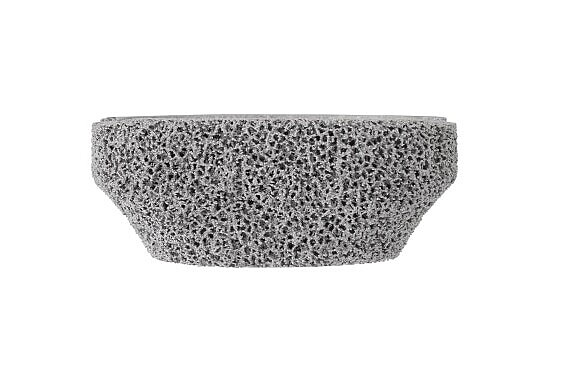
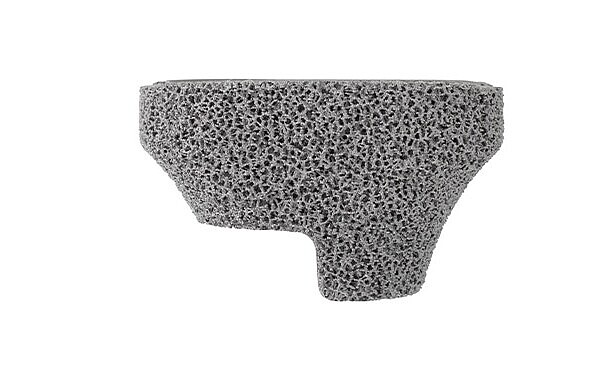
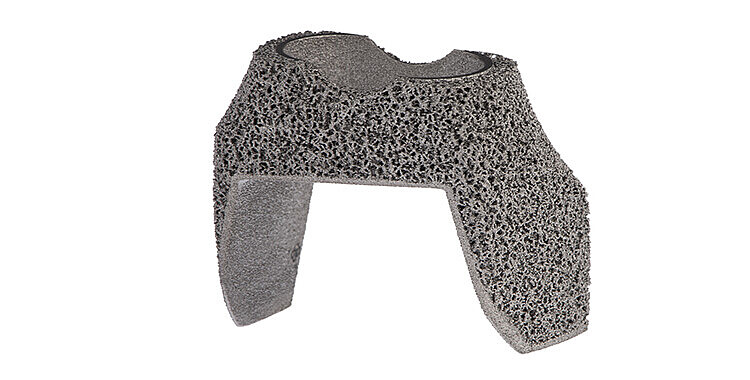
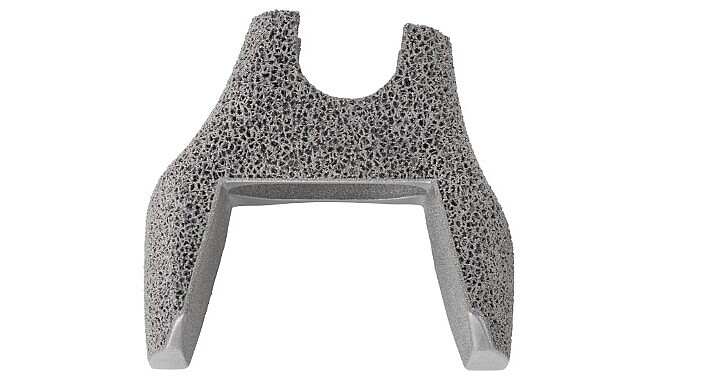
EPORE® Cones cortical
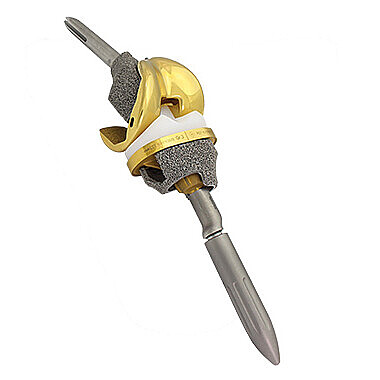
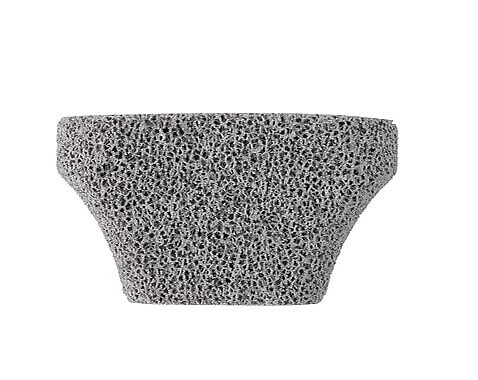
EPORE® cones cortical serve as augmentations to fill metaphyseal bone defects with accompanying cortical damage and create a stable support surface for the implantation of a knee endoprosthesis. They are compatible with the ACS® SC system and the MUTARS® GenuX® MK system and can be combined with spacers. Furthermore, comprehensive modularity is ensured by offset adapters with 360° rotational freedom and various stems.
By implementing the concept of zonal fixation, they provide a solid support surface for knee endoprostheses and enable the restoration of the natural joint line.1) EPORE® defect fillers also demonstrate excellent osseointegration and show promising short-term clinical results.2)
1) Morgan-Jones R, Oussedik SIS, Graichen H, Haddad FS. Zonal fixation in revision total knee arthroplasty. Bone Joint J. 2015;97-B(2):147-149.
2) Thomas England, Joseph Pagkalos, Lee Jeys, Rajesh Botchu, Richard Carey Smith. Additive manufacturing of porous titanium metaphyseal components: Early osseointegration and implant stability in revision knee arthroplasty,Journal of Clinical Orthopaedics and Trauma, Volume 15: 60-64 (2021)
- Central and decentralized metaphysical bone defects with accompanying cortical defect in the distal femur or proximal tibia
- Defective guided preparation (independent alignment of cone to knee endoprosthesis)
- Anatomically shaped
- Symmetrical tibial and femoral design
- Asymmetrical tibial design
- EPORE®; TiAl6V4
- 4 tibial sizes (height: 20 and 30 mm)
4 femoral sizes (height: 30, 40, and 50 mm)
- symmetrical and asymmetrical tibial version
- symmetrical femoral version
Compatible with:
- cemented ACS® SC components
- cemented MUTARS® GenuX® MK components
- Spacer: femoral (posterior and distal, each in 5 mm and 10 mm), tibial (5 mm and 10 mm)
- Offset adapter (femoral: 0 mm, 2 mm, 4 mm, 6 mm; tibial: 0 mm, 2 mm, 4 mm, 6 mm)
- Cemented and cementless stems
- CE Marking
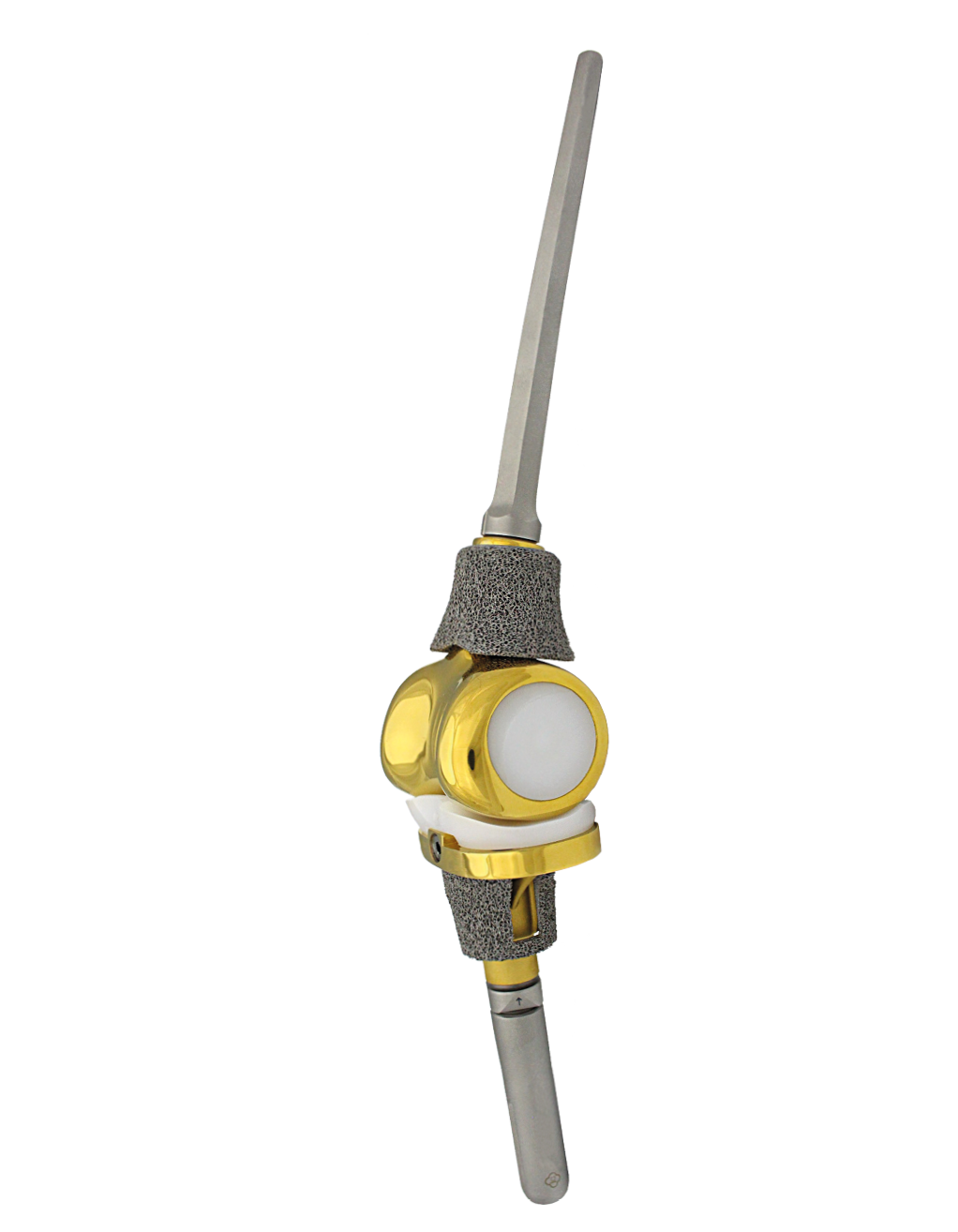
MUTARS® KRI with EPORE®
metaphyseal cones
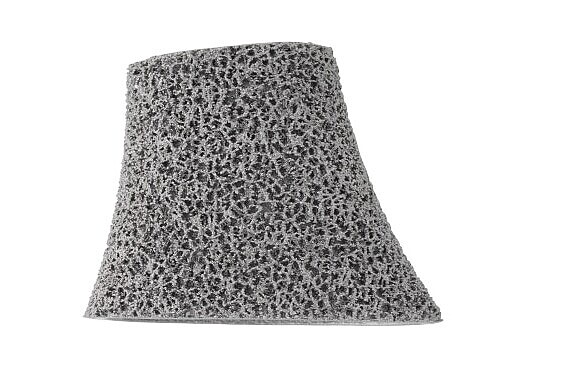
EPORE® metaphyseal
cones femoral
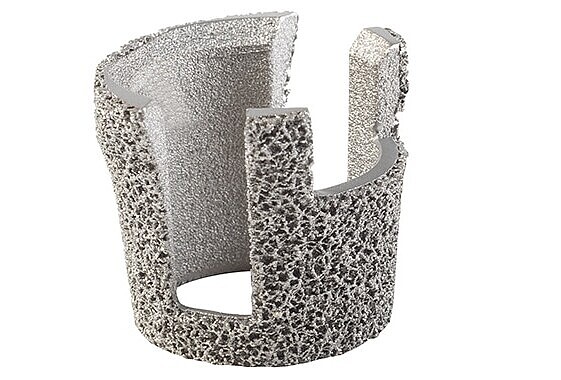
EPORE® metaphyseal
cones tibial
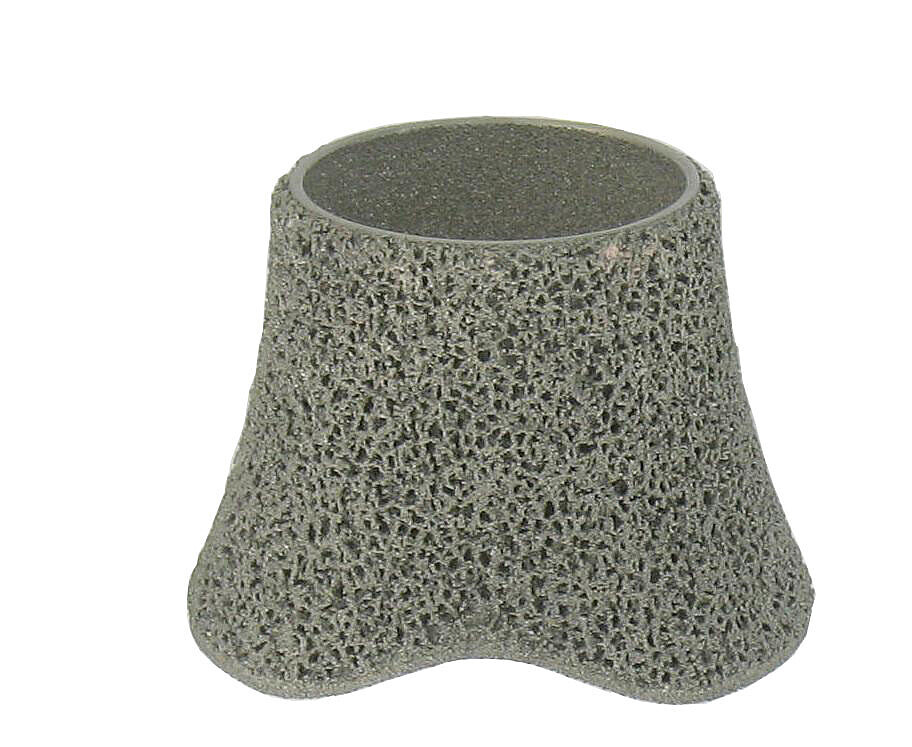
EPORE® metaphyseal
cones KRI
EPORE® Cones metaphyseal
EPORE® metaphyseal cones serve as augmentations to fill smaller central defects in the metaphyseal region without cortical damage and create a stable support surface for the implantation of a knee endoprosthesis. They are compatible with the ACS® SC system and the MUTARS® GenuX® MK and KRI system and can also be combined with spacers. Furthermore, freely adjustable offset adapters and stems ensure a comprehensive modularity.
By implementing the concept of zonal fixation, they provide a solid support surface for knee endoprostheses and enable the restoration of the natural joint line.1) EPORE® defect fillers also demonstrate excellent osseointegration and deliver impressive short-term clinical results.2)
1) Morgan-Jones R, Oussedik SIS, Graichen H, Haddad FS. Zonal fixation in revision total knee arthroplasty. Bone Joint J. 2015;97-B(2):147-149.
2) Thomas England, Joseph Pagkalos, Lee Jeys, Rajesh Botchu, Richard Carey Smith. Additive manufacturing of porous titanium metaphyseal components: Early osseointegration and implant stability in revision knee arthroplasty,Journal of Clinical Orthopaedics and Trauma, Volume 15: 60-64 (2021)
- smaller central defects in the metaphyseal region without cortical damage in the distal femur or proximal tibia
- Defective guided preparation (independent alignment of cone to knee endoprosthesis)
- Anatomically shaped
- symmetrical tibial and femoral design
- asymmetrical femoral design
- EPORE®; TiAl6V4
- 4 tibial sizes (height: 29 mm)
4 femoral sizes (height: 30 mm)
- symmetrical tibial version and femoral version
- asymmetrical femoral version
Compatible with:
- cemented ACS® SC components
- cemented MUTARS® GenuX® MK components and KRI
- Spacer: femoral (posterior and distal, each in 5 mm and 10 mm), tibial (5 mm and 10 mm)
- Offset adapter (femoral: 0 mm, 2 mm, 4 mm, 6 mm; tibial: 0 mm, 2 mm, 4 mm, 6 mm)
- Cemented and cementless Stems
- CE Marking
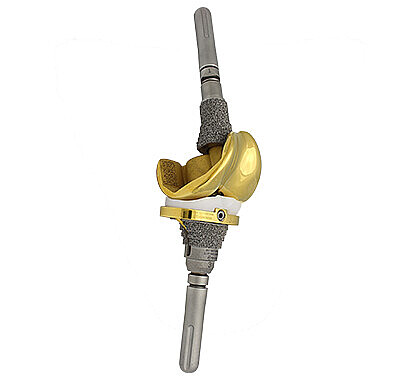
GenuX with EPORE®
metaphyseal components
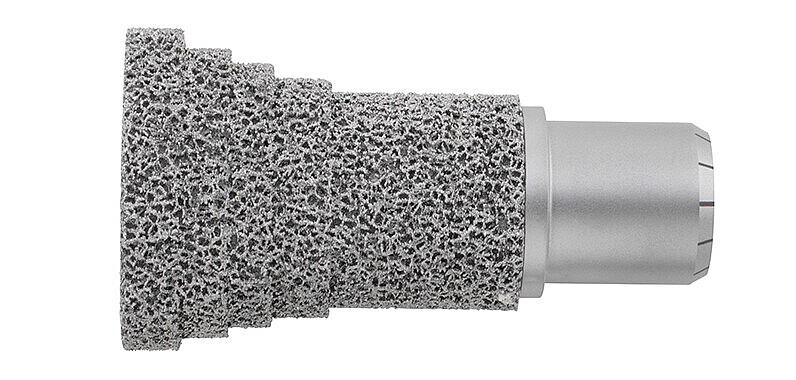
EPORE® metaphyseal
components femoral
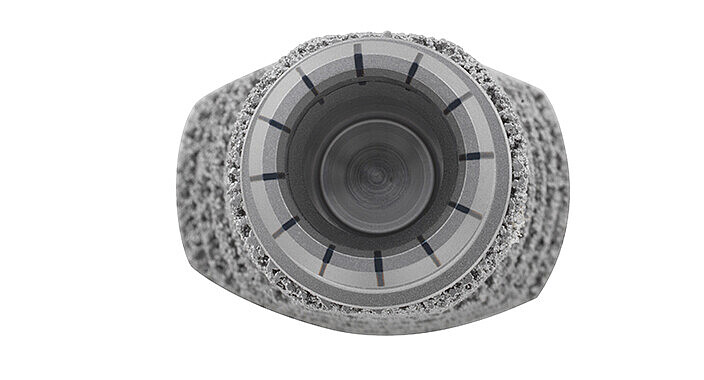
EPORE® metaphyseal
components femoral
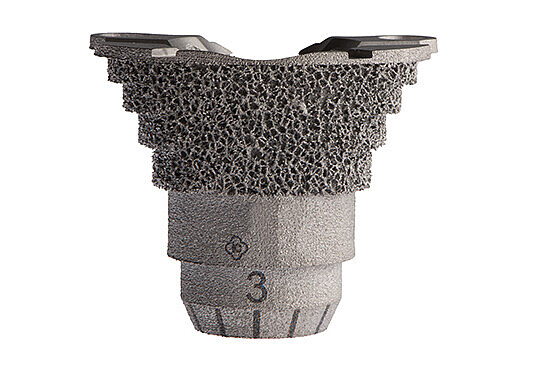
EPORE® MB metaphyseal
components tibial
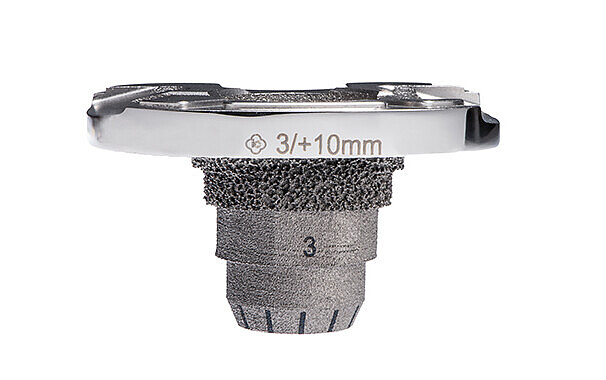
EPORE® MB metaphyseal
components with spacer
tibial
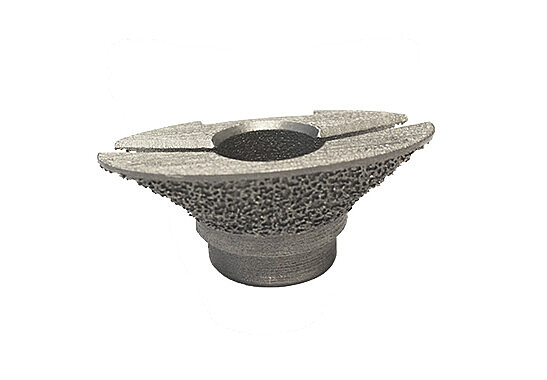
EPORE® FB metaphyseal
components tibial
EPORE® metaphyseal components
EPORE® metaphyseal components are indicated for the treatment of central bone defects in the metaphysis and provide a reliable foundation for both the rotational and axial stability of the knee endoprosthesis. The stepped design results in a vertically directed force transmission and consequently leads to compressive loading of the bone. Due to the mechanical connection of the components, EPORE® metaphyseal components can be used in both cemented and cementless implantations. They are compatible with the ACS® SC system and the MUTARS® GenuX® MK system and are also available with integrated tibial spacer. Furthermore, freely adjustable offset adapters and stems ensure a comprehensive modularity.
By implementing the concept of zonal fixation, they provide a reliable foundation for knee endoprostheses and enable the restoration of the natural joint line.1) EPORE® defect fillers show excellent osseointegration and demonstrate impressive short-term clinical outcomes.2)
1) Morgan-Jones R, Oussedik SIS, Graichen H, Haddad FS. Zonal fixation in revision total knee arthroplasty. Bone Joint J. 2015;97-B(2):147-149.
2) Thomas England, Joseph Pagkalos, Lee Jeys, Rajesh Botchu, Richard Carey Smith. Additive manufacturing of porous titanium metaphyseal components: Early osseointegration and implant stability in revision knee arthroplasty,Journal of Clinical Orthopaedics and Trauma, Volume 15: 60-64 (2021)
- central bone defects in the metaphysis in the distal femur or proximal tibia
- Axial guided preparation
- Anatomically shaped
- symmetrical tibial design (with or without integrated spacer)
- asymmetrical femoral funnel design
- EPORE®; TiAl6V4
- 4 tibial sizes (height: 30 mm)
- 4 femoral sizes (height: 30 mm)
- symmetrical tibial version without spacer
- symmetrical tibial version incl. spacer (5mm and 10mm)
- asymmetrical femoral version
Compatible with:
- cemented and cementless ACS® SC components
- cemented and cementless MUTARS® GenuX® MK components
- Spacer: femoral (posterior and distal, each in 5 mm and 10 mm), tibial (5 mm and 10 mm)
- Offset adapter (femoral: 0 mm, 2 mm, 4 mm, 6 mm; tibial: 0 mm, 2 mm, 4 mm, 6 mm)
- cemented and cementless stems
- CE Marking