- central bone defects in the metaphysis in the distal femur or proximal tibia

EPORE®
EPORE® is an additively manufactured, highly porous structure based on a titanium alloy (TiAl6V4). This material is particularly suitable for implant components because it is biologically inert and ductile, and has high corrosion resistance and fatigue strength.
EPORE® was developed to create a high porosity with a low modulus of elasticity. It is very similar to the structure of bone and thus promotes the ingrowth of the implant into the bone.

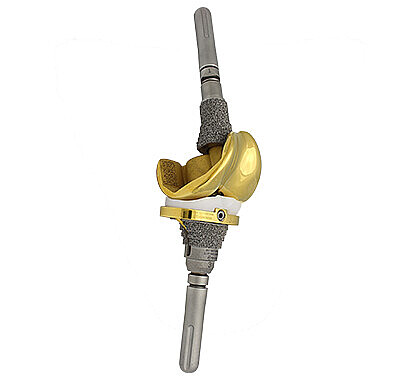
GenuX with EPORE®
metaphyseal components
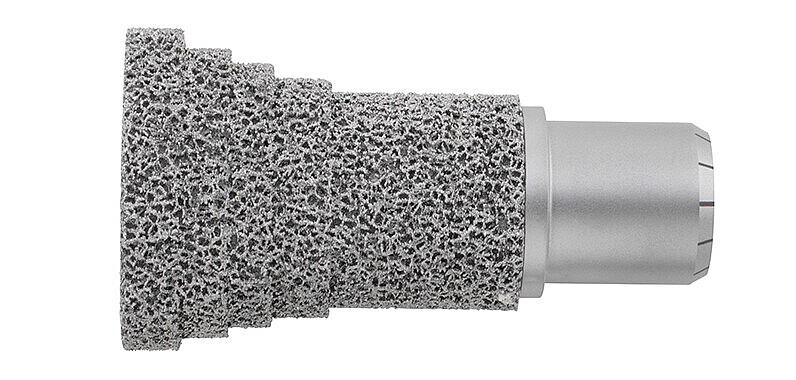
EPORE® metaphyseal
components femoral
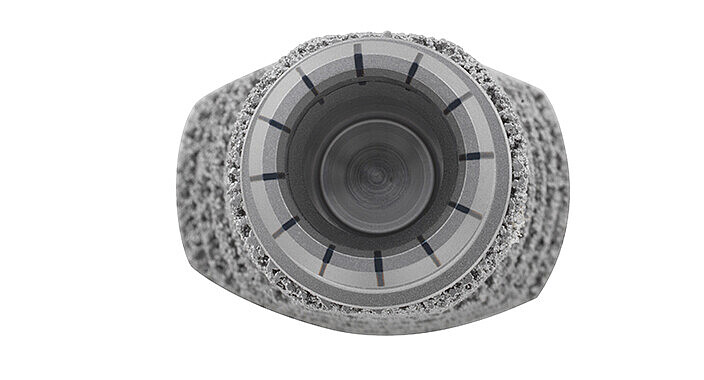
EPORE® metaphyseal
components femoral
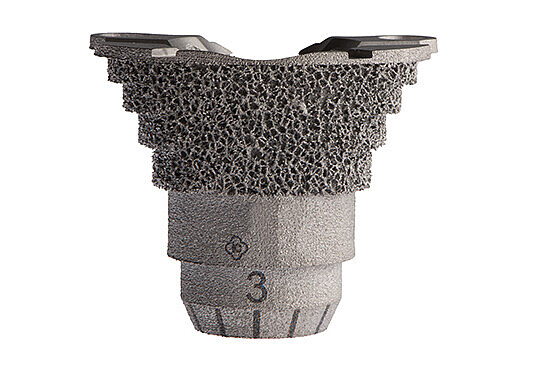
EPORE® MB metaphyseal
components tibial
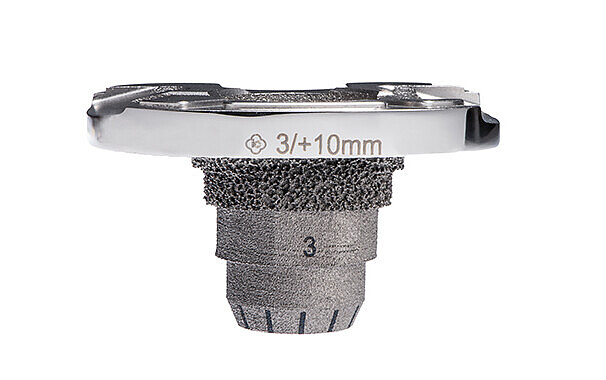
EPORE® MB metaphyseal
components with spacer
tibial
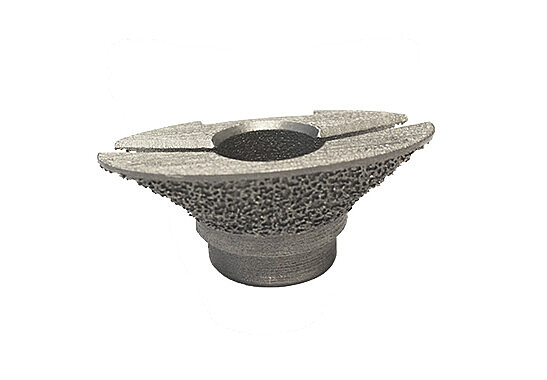
EPORE® FB metaphyseal
components tibial
EPORE® metaphyseal components
EPORE® metaphyseal components are indicated for the treatment of central bone defects in the metaphysis and provide a reliable foundation for both the rotational and axial stability of the knee endoprosthesis. The stepped design results in a vertically directed force transmission and consequently leads to compressive loading of the bone. Due to the mechanical connection of the components, EPORE® metaphyseal components can be used in both cemented and cementless implantations. They are compatible with the ACS® SC system and the MUTARS® GenuX® MK system and are also available with integrated tibial spacer. Furthermore, freely adjustable offset adapters and stems ensure a comprehensive modularity.
By implementing the concept of zonal fixation, they provide a reliable foundation for knee endoprostheses and enable the restoration of the natural joint line.1) EPORE® defect fillers show excellent osseointegration and demonstrate impressive short-term clinical outcomes.2)
1) Morgan-Jones R, Oussedik SIS, Graichen H, Haddad FS. Zonal fixation in revision total knee arthroplasty. Bone Joint J. 2015;97-B(2):147-149.
2) Thomas England, Joseph Pagkalos, Lee Jeys, Rajesh Botchu, Richard Carey Smith. Additive manufacturing of porous titanium metaphyseal components: Early osseointegration and implant stability in revision knee arthroplasty,Journal of Clinical Orthopaedics and Trauma, Volume 15: 60-64 (2021)
- Axial guided preparation
- Anatomically shaped
- symmetrical tibial design (with or without integrated spacer)
- asymmetrical femoral funnel design
- EPORE®; TiAl6V4
- 4 tibial sizes (height: 30 mm)
- 4 femoral sizes (height: 30 mm)
- symmetrical tibial version without spacer
- symmetrical tibial version incl. spacer (5mm and 10mm)
- asymmetrical femoral version
Compatible with:
- cemented and cementless ACS® SC components
- cemented and cementless MUTARS® GenuX® MK components
- Spacer: femoral (posterior and distal, each in 5 mm and 10 mm), tibial (5 mm and 10 mm)
- Offset adapter (femoral: 0 mm, 2 mm, 4 mm, 6 mm; tibial: 0 mm, 2 mm, 4 mm, 6 mm)
- cemented and cementless stems
- CE Marking
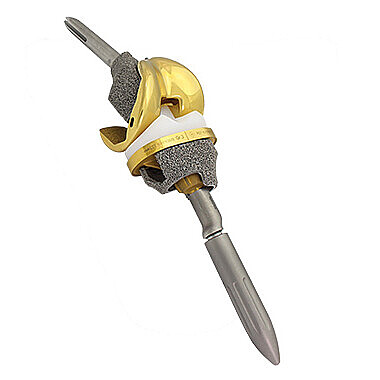
ACS® SC MB with EPORE®
cortical cones
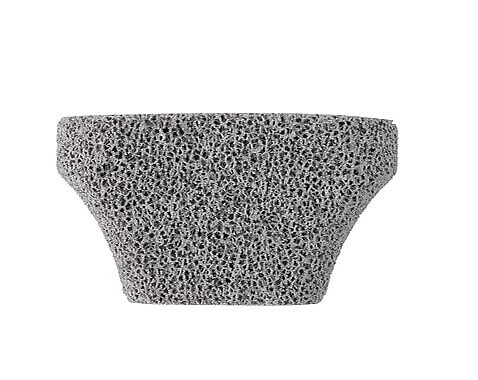
EPORE® cortical cones
tibial
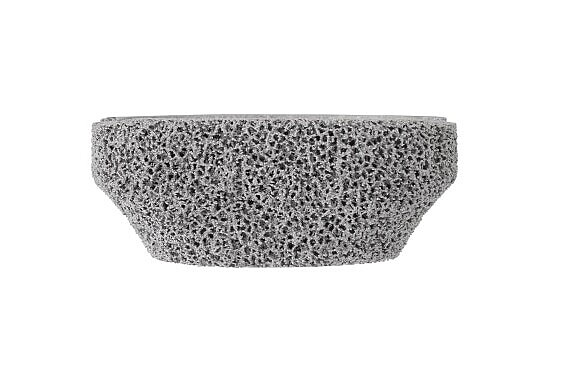
EPORE® cortical cones
tibial
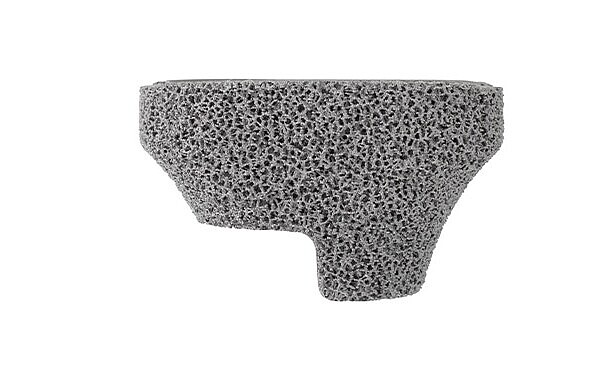
EPORE® cortical cones
tibial
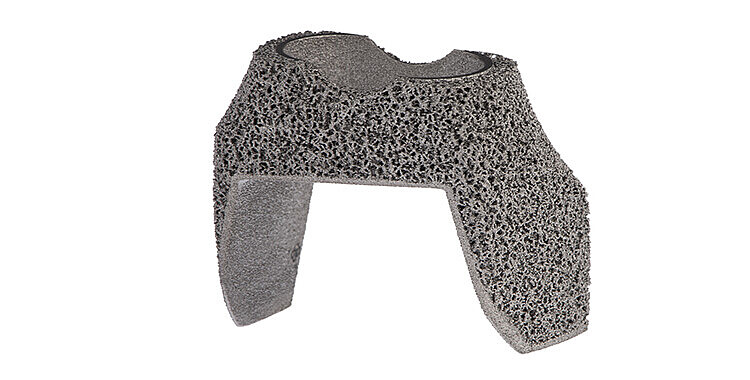
EPORE® cortical cones
femoral
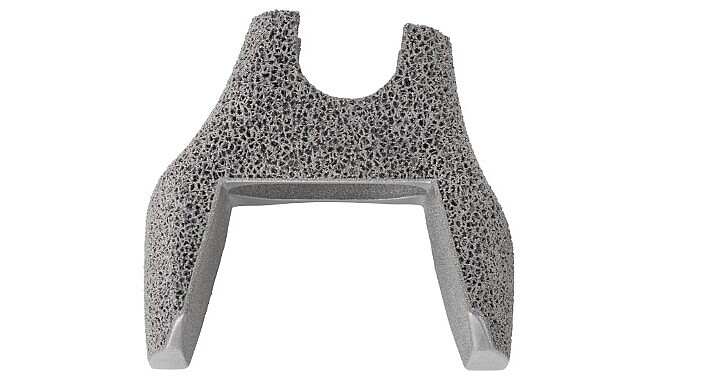
EPORE® cortical cones
femoral
EPORE® Cones cortical
EPORE® cones cortical serve as augmentations to fill metaphyseal bone defects with accompanying cortical damage and create a stable support surface for the implantation of a knee endoprosthesis. They are compatible with the ACS® SC system and the MUTARS® GenuX® MK system and can be combined with spacers. Furthermore, comprehensive modularity is ensured by offset adapters with 360° rotational freedom and various stems.
By implementing the concept of zonal fixation, they provide a solid support surface for knee endoprostheses and enable the restoration of the natural joint line.1) EPORE® defect fillers also demonstrate excellent osseointegration and show promising short-term clinical results.2)
1) Morgan-Jones R, Oussedik SIS, Graichen H, Haddad FS. Zonal fixation in revision total knee arthroplasty. Bone Joint J. 2015;97-B(2):147-149.
2) Thomas England, Joseph Pagkalos, Lee Jeys, Rajesh Botchu, Richard Carey Smith. Additive manufacturing of porous titanium metaphyseal components: Early osseointegration and implant stability in revision knee arthroplasty,Journal of Clinical Orthopaedics and Trauma, Volume 15: 60-64 (2021)
- Central and decentralized metaphysical bone defects with accompanying cortical defect in the distal femur or proximal tibia
- Defective guided preparation (independent alignment of cone to knee endoprosthesis)
- Anatomically shaped
- Symmetrical tibial and femoral design
- Asymmetrical tibial design
- EPORE®; TiAl6V4
- 4 tibial sizes (height: 20 and 30 mm)
4 femoral sizes (height: 30, 40, and 50 mm)
- symmetrical and asymmetrical tibial version
- symmetrical femoral version
Compatible with:
- cemented ACS® SC components
- cemented MUTARS® GenuX® MK components
- Spacer: femoral (posterior and distal, each in 5 mm and 10 mm), tibial (5 mm and 10 mm)
- Offset adapter (femoral: 0 mm, 2 mm, 4 mm, 6 mm; tibial: 0 mm, 2 mm, 4 mm, 6 mm)
- Cemented and cementless stems
- CE Marking
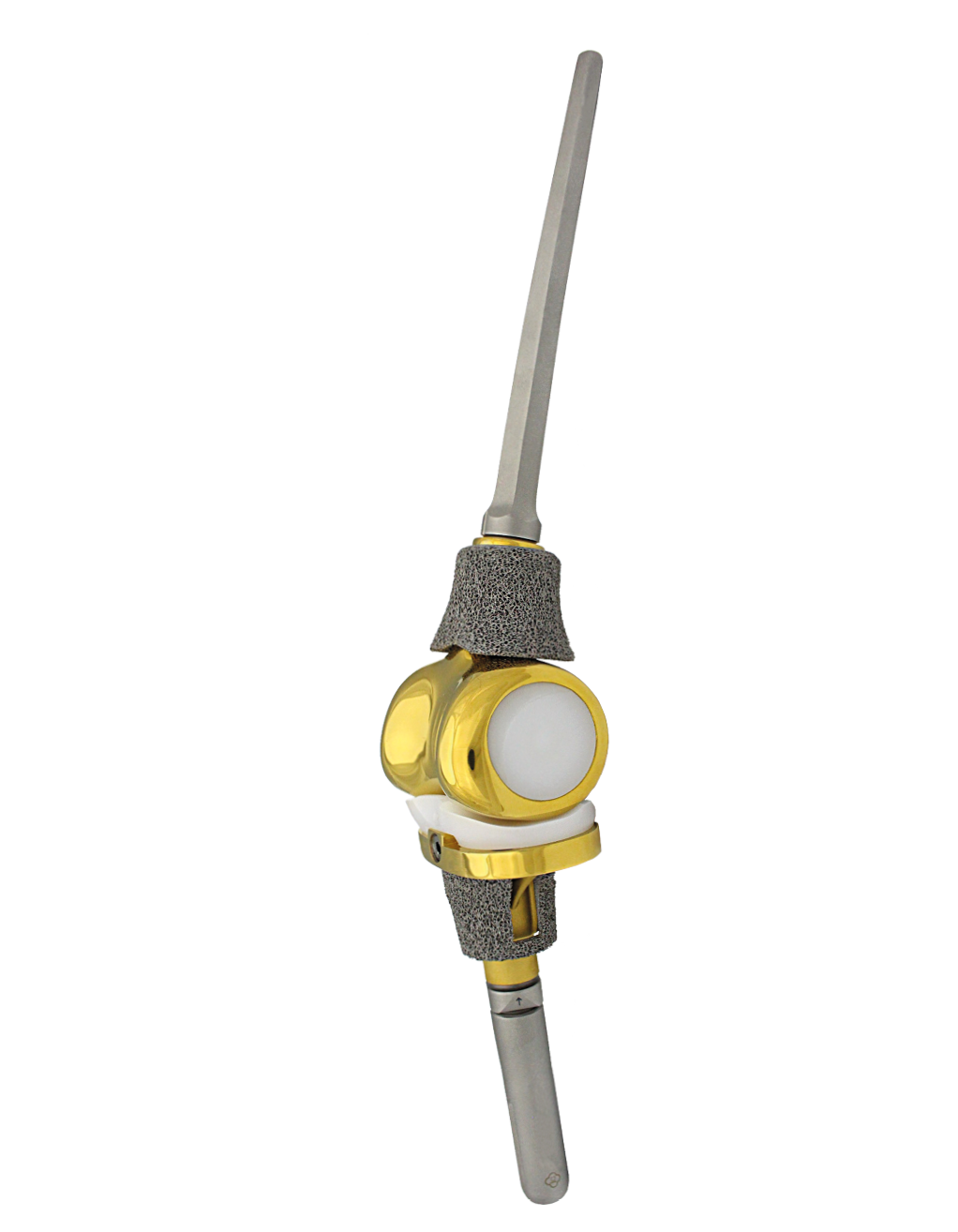
MUTARS® KRI with EPORE®
metaphyseal cones
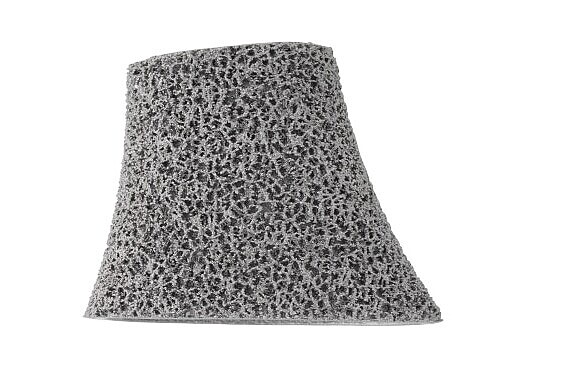
EPORE® metaphyseal
cones femoral
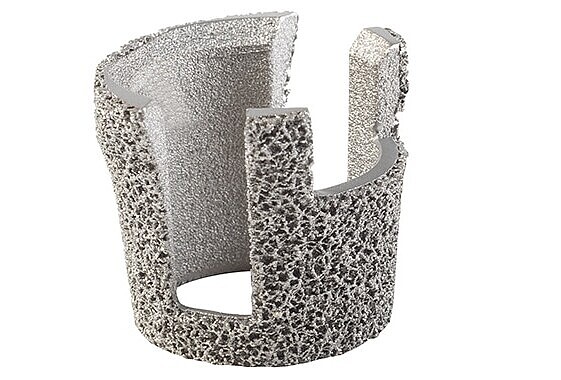
EPORE® metaphyseal
cones tibial
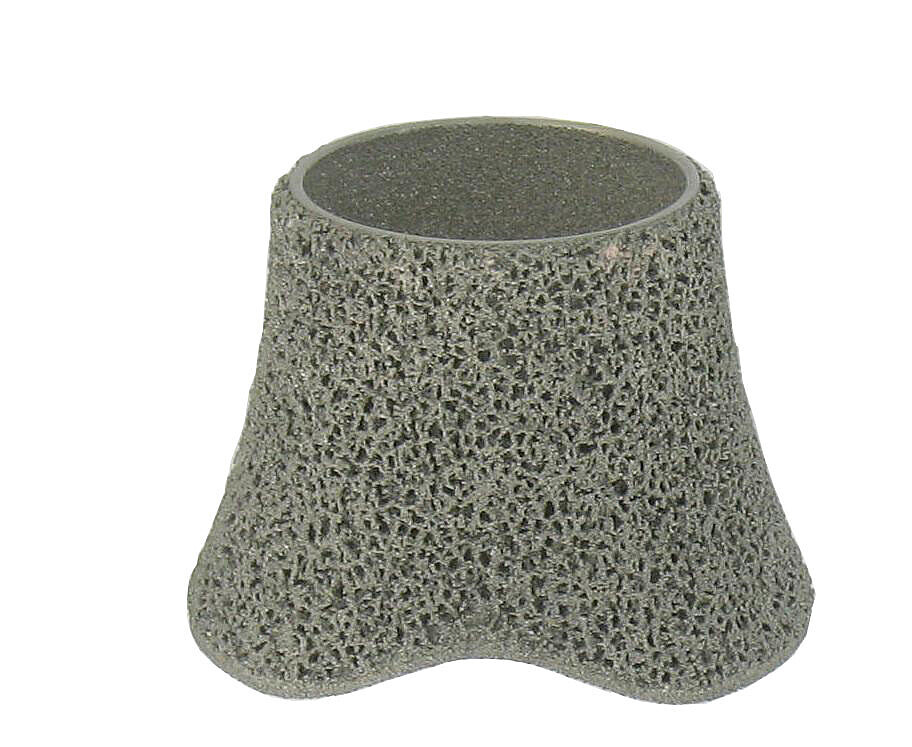
EPORE® metaphyseal
cones KRI
EPORE® Cones metaphyseal
EPORE® metaphyseal cones serve as augmentations to fill smaller central defects in the metaphyseal region without cortical damage and create a stable support surface for the implantation of a knee endoprosthesis. They are compatible with the ACS® SC system and the MUTARS® GenuX® MK and KRI system and can also be combined with spacers. Furthermore, freely adjustable offset adapters and stems ensure a comprehensive modularity.
By implementing the concept of zonal fixation, they provide a solid support surface for knee endoprostheses and enable the restoration of the natural joint line.1) EPORE® defect fillers also demonstrate excellent osseointegration and deliver impressive short-term clinical results.2)
1) Morgan-Jones R, Oussedik SIS, Graichen H, Haddad FS. Zonal fixation in revision total knee arthroplasty. Bone Joint J. 2015;97-B(2):147-149.
2) Thomas England, Joseph Pagkalos, Lee Jeys, Rajesh Botchu, Richard Carey Smith. Additive manufacturing of porous titanium metaphyseal components: Early osseointegration and implant stability in revision knee arthroplasty,Journal of Clinical Orthopaedics and Trauma, Volume 15: 60-64 (2021)
- smaller central defects in the metaphyseal region without cortical damage in the distal femur or proximal tibia
- Defective guided preparation (independent alignment of cone to knee endoprosthesis)
- Anatomically shaped
- symmetrical tibial and femoral design
- asymmetrical femoral design
- EPORE®; TiAl6V4
- 4 tibial sizes (height: 29 mm)
4 femoral sizes (height: 30 mm)
- symmetrical tibial version and femoral version
- asymmetrical femoral version
Compatible with:
- cemented ACS® SC components
- cemented MUTARS® GenuX® MK components and KRI
- Spacer: femoral (posterior and distal, each in 5 mm and 10 mm), tibial (5 mm and 10 mm)
- Offset adapter (femoral: 0 mm, 2 mm, 4 mm, 6 mm; tibial: 0 mm, 2 mm, 4 mm, 6 mm)
- Cemented and cementless Stems
- CE Marking